AI vs Traditional Programming: What's the Difference?
Discover the key differences between AI and traditional programming, how each approach solves problems, and why modern businesses are combining both with platforms like Enter Pro to build smarter solutions faster.
Traditional programming has powered software development for decades, but artificial intelligence is changing how applications are built and maintained. Understanding AI vs traditional programming is essential for businesses, developers, and technology leaders looking to stay competitive.
While traditional programming relies on predefined rules and logic written by developers, AI systems learn patterns from data and improve their performance over time. Both approaches have unique strengths and limitations. Rather than replacing traditional coding entirely, AI is becoming a powerful complement that helps developers build smarter, faster, and more adaptive applications. This article explores the core differences, use cases, and future of these two paradigms.
What is traditional programming?
Traditional programming is a software development approach where developers write explicit instructions that tell a computer exactly how to perform a task. The program follows predefined rules, logic, and conditions to process inputs and produce predictable outputs. Every possible scenario must be anticipated and coded manually, making the system highly structured and reliable. This approach works best for applications with clear requirements, such as payroll systems, accounting software, inventory management, and banking platforms. Because the logic is transparent and easy to debug, traditional programming remains widely used for business-critical applications that require accuracy, consistency, and control.

What is AI programming
AI programming is the process of creating systems that can learn from data, recognize patterns, and make decisions with minimal human intervention. Instead of relying solely on predefined rules, AI models are trained using large datasets and algorithms that help them improve over time. This approach enables computers to solve complex problems, generate predictions, and adapt to new information. AI programming powers technologies such as chatbots, recommendation engines, image recognition, speech processing, and predictive analytics. It is especially useful for tasks where writing explicit rules for every possible scenario would be difficult or impractical.
AI vs traditional programming comparison
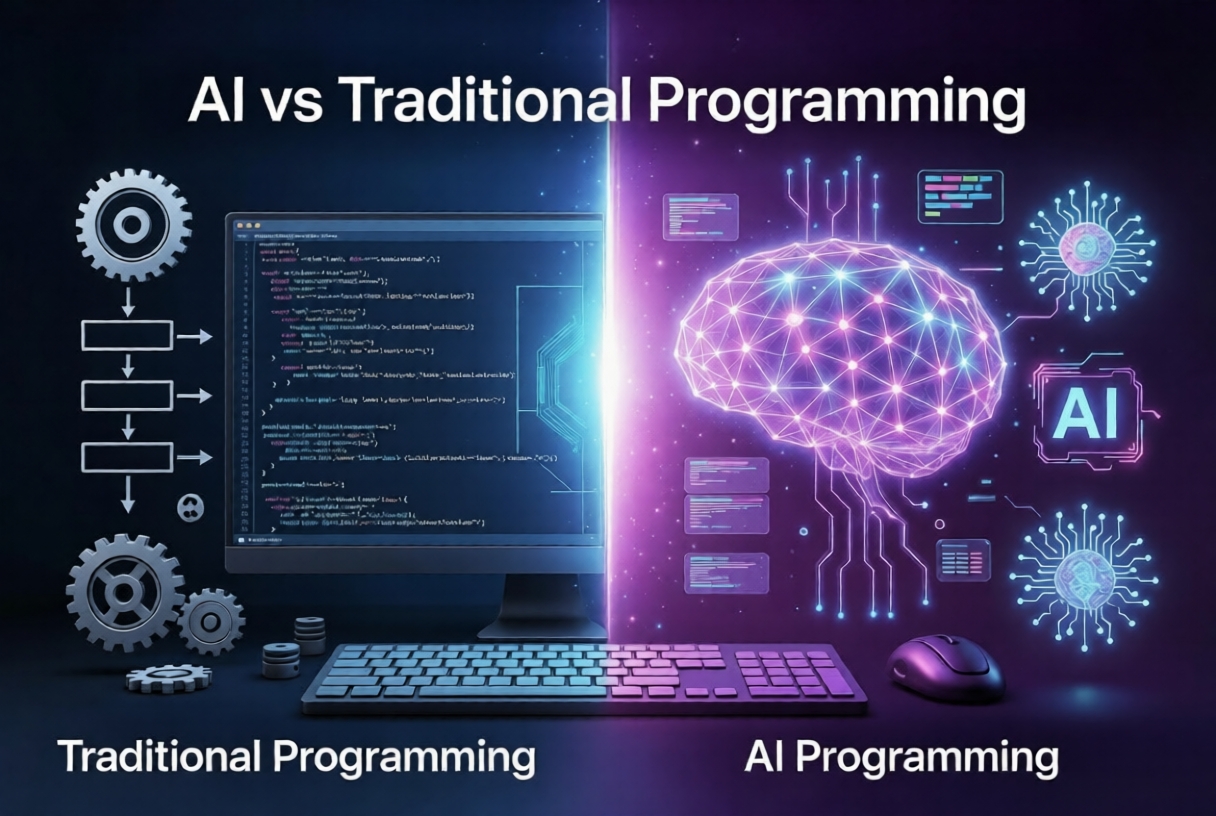
| Feature | Traditional Programming | AI Programming |
| Approach | Rule-based, explicit instructions | Data-driven, pattern recognition |
| Learning | No learning; behavior is fixed | Continuously improves from data |
| Flexibility | Requires manual updates for changes | Adapts automatically to new inputs |
| Error handling | Developer must identify and fix errors | Can self-correct through training |
| Data type | Structured, well-defined data | Unstructured data - text, images, audio |
| Best for | Clear, stable, well-defined problems | Complex, dynamic, ambiguous problems |
| Transparency | Fully auditable logic | Often a black box |
Key AI vs traditional programming differences
Before choosing between AI and rule-based systems, it is important to understand the core differences between them. These distinctions affect how software is built, maintained, and used to solve real-world problems.
Learning and adaptation
Traditional programming relies on rules and instructions written by developers. The software performs only what it has been explicitly programmed to do. AI systems can learn from data, recognize patterns, and improve their performance over time. This ability allows AI applications to adapt to changing situations without requiring constant manual code updates.
Decision-making process
In traditional programming, decisions are made using predefined logic and conditions created by developers. Every possible scenario must be anticipated and coded. AI systems make decisions by analyzing data and identifying patterns. This enables them to handle complex situations where creating detailed rule sets would be difficult or impractical.
Data requirements
In traditional programming, decisions are made using predefined logic and conditions created by developers. Every possible scenario must be anticipated and coded. AI systems make decisions by analyzing data and identifying patterns. This enables them to handle complex situations where creating detailed rule sets would be difficult or impractical.
Output predictability
Traditional software produces consistent and predictable results when given the same input. This reliability makes it suitable for critical business processes and calculations. AI systems generate outputs based on probabilities and learned patterns, which means results can vary depending on the model, training data, and context.
Problem-solving capabilities
Traditional programming is ideal for structured tasks such as calculations, transaction processing, and workflow management. AI excels at solving problems involving pattern recognition, prediction, language understanding, and image analysis, where rigid rule-based approaches often struggle to perform effectively.
Maintenance and updates
Maintaining traditional software typically requires developers to modify code whenever requirements change. AI systems are often improved by retraining models with new data rather than rewriting large portions of the application. This allows AI solutions to evolve and remain effective as user needs and environments change.
Advantages and limitations of traditional and AI programming
Both traditional and AI programming offer unique strengths and challenges. Understanding their advantages and limitations helps developers and businesses choose the most effective approach for specific applications and goals.
Traditional programming
Advantages
- Predictable and consistent results: Traditional programs produce the same output for the same input, making them highly reliable for business-critical applications and structured workflows.
- Easy to debug and maintain: Since all rules and logic are explicitly written by developers, identifying errors and making updates is generally more straightforward and transparent.
- High level of control: Developers have complete control over how the system behaves, which is especially important in industries with strict compliance, security, and accuracy requirements.
Limitations
- Cannot learn from experience: Traditional software follows predefined instructions and cannot improve or adapt automatically without manual code modifications.
- Difficult to handle complex scenarios: Creating rules for every possible situation becomes challenging when dealing with large datasets, unpredictable inputs, or changing environments.
- Requires continuous manual updates: Any new requirement, business rule, or process change often requires developers to revise and redeploy the code.
AI programming
Advantages
- Learns and improves over time: AI models can analyze data, identify patterns, and enhance their performance through training, making them suitable for evolving use cases.
- Handles complex problems effectively: AI excels at tasks such as image recognition, natural language processing, recommendation systems, and predictive analytics, where traditional rules may fall short.
- Automates intelligent decision-making: AI can process large volumes of information quickly, helping organizations improve efficiency, personalization, and operational insights.
Limitations
- Requires large amounts of data: AI systems depend on quality training data, and poor or limited datasets can significantly impact performance and accuracy.
- Less transparent decision-making: Many AI models function as black boxes, making it difficult to understand exactly how certain conclusions or predictions are generated.
- Higher resource requirements: Training and maintaining AI models often requires significant computing power, specialized expertise, and ongoing monitoring to ensure reliable results.
Why hybrid development is becoming the standard
Modern software increasingly combines AI and traditional programming.
For example:
- Traditional code manages business rules.
- AI handles recommendations and predictions.
- Rule-based systems enforce compliance.
- Machine learning adapts to changing user behavior.
This hybrid approach provides the reliability of traditional programming alongside the intelligence and adaptability of AI. Industry trends show that developers who understand both disciplines are becoming increasingly valuable.
Enter Pro: Build intelligent software without code
The evolution of AI vs traditional programming comparison highlights a clear trend: software creation is moving away from complex manual coding and toward intuitive, high-level instruction. Leading this new era of digital product creation is Enter Pro, an AI-driven ecosystem.
Enter Pro serves as a unified development environment that fully abstracts complex engineering tasks such as backend logic, database management, and API integration. Instead of spending months writing thousands of lines of traditional code, Enter Pro allows users to design web applications, responsive websites, custom chatbots, and automated workflows simply by using natural language prompts.
By connecting directly to advanced large language models through a single interface, Enter Pro gives creators, founders, and educators the power to convert ideas into functional software in minutes. The platform shifts development control toward true AI ownership, enabling you to build, customize, and launch production-ready tools with zero traditional coding experience required.
Key features of Enter Pro
Native AI at the core
Enter Pro integrates multiple leading LLMs like GPT, Claude, Gemini, and Grok through a unified API. Build custom AI agents for design, coding, and planning. Automate complex workflows and turn ideas into production-ready applications faster than ever.
Cloud backend & integrations
Get instant access to database, storage, serverless functions, and cron jobs. Seamlessly connect with Supabase, Stripe, Google Analytics, GitHub, and more. Build full-stack applications without managing infrastructure yourself.
Visual editor with real-time preview
Edit your website or app directly on the live preview with our visual editor. Modify layouts, colors, fonts, and elements visually while AI handles the underlying code. Build and iterate at lightning speed with intuitive design tools.
Team workspace & collaboration
Create shared workspaces, invite team members, and assign roles. Collaborate in real-time with AI-assisted reviews, comments, and task management. Perfect for developers, designers, and product teams working together efficiently.
One-click deployment & hosting
Deploy your projects instantly to a global edge network with a single click. Connect custom domains and scale effortlessly. Export clean, standard code anytime for full ownership and flexibility.
Steps to build websites with Enter Pro
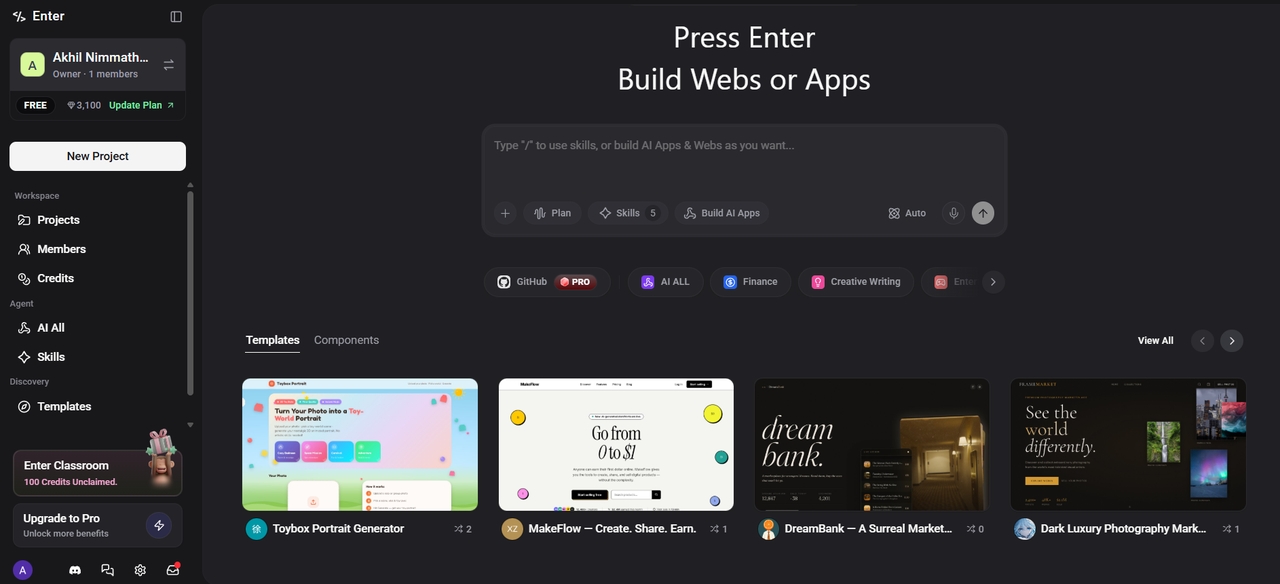
Step 1: Describe your ddea
Begin by sharing your vision with Enter Pro. Simply describe what kind of website you want — whether it's a portfolio, a business landing page, an online store, or anything else. The more detail you provide about your goals, style preferences, and content needs, the better the platform can understand and bring your idea to life. Next, hit "Build."
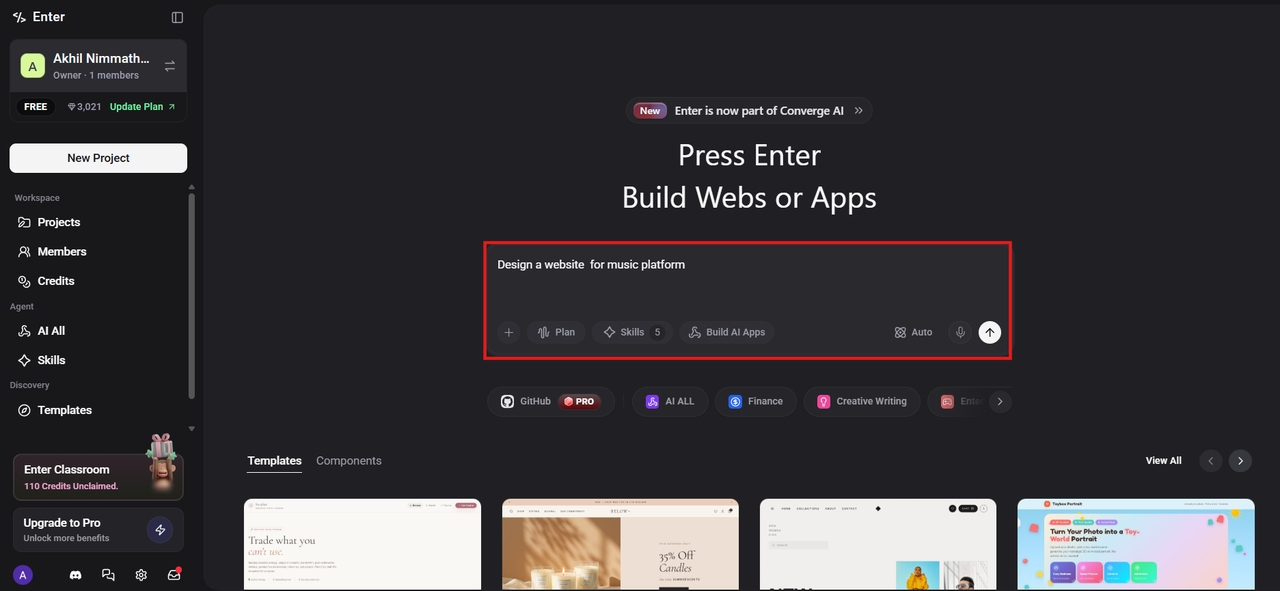
Step 2: Refine with AI and visual editor
Once your initial concept is generated, you can fine-tune every aspect of your website using a combination of AI prompts and an intuitive visual editor. Adjust layouts, colors, fonts, and content in real time, collaborating with the AI to get the design exactly the way you want it — no coding skills required.

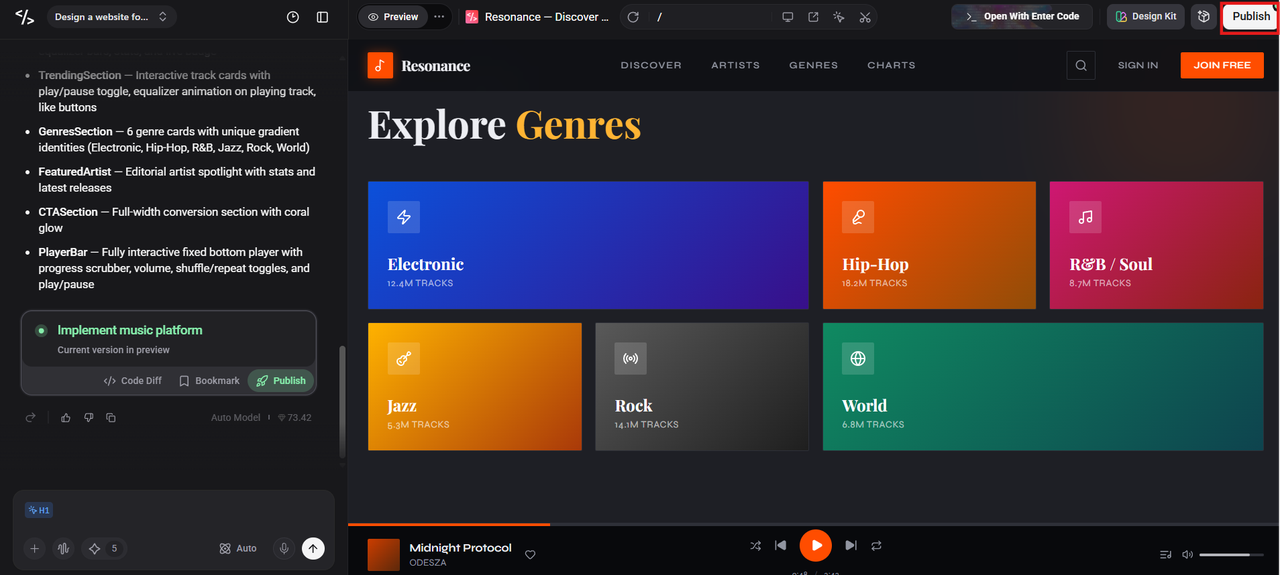
Step 3: Publish
When you're happy with the result, simply hit the Publish button and your website goes live instantly. Enter Pro takes care of all the technical details behind the scenes, making your site accessible to visitors around the world so you can focus on what matters most — growing your presence online.
Conclusion
The comparison between AI and traditional programming highlights that both approaches serve important roles in modern software development. Traditional programming provides reliability, transparency, and control, while AI delivers adaptability, automation, and advanced problem-solving capabilities. Rather than competing, these technologies work best together to create smarter and more efficient applications. As businesses continue to adopt AI-powered solutions, understanding the strengths and limitations of each approach will help developers and organizations make informed decisions and build future-ready software that meets evolving user needs.
FAQs
What is the main difference between AI and traditional programming?
The main difference is that traditional programming follows predefined rules written by developers, while AI systems learn patterns from data and make decisions based on those learned insights. AI can adapt over time, whereas traditional software requires manual updates.
Can AI completely replace traditional programming?
No. AI excels at pattern recognition and handling uncertainty, but traditional programming remains essential for rule-based logic, security, performance-critical systems, and ensuring transparency and reliability. The best solutions combine both.
Why does AI require large amounts of data?
AI models learn by analyzing examples and identifying patterns within data. Larger, high-quality datasets generally help improve accuracy, reduce errors, and enable AI systems to make more reliable predictions and decisions.
Will AI take away programming jobs?
AI is transforming jobs rather than replacing them. Developers who combine traditional programming skills with AI proficiency will be in high demand for building, managing, and improving intelligent systems.
Can AI write code on its own?
AI can generate code snippets, suggest solutions, and automate repetitive coding tasks. However, human developers are still needed to review code, design system architecture, ensure security, and validate application performance.