Aletheia automates class-action settlement claims using Enter
Aletheia automates class-action settlement claims using your purchase history. Detect chemical exposure, match eligible settlements, and file with ease.
"Justice is truth in action." — Benjamin Disraeli
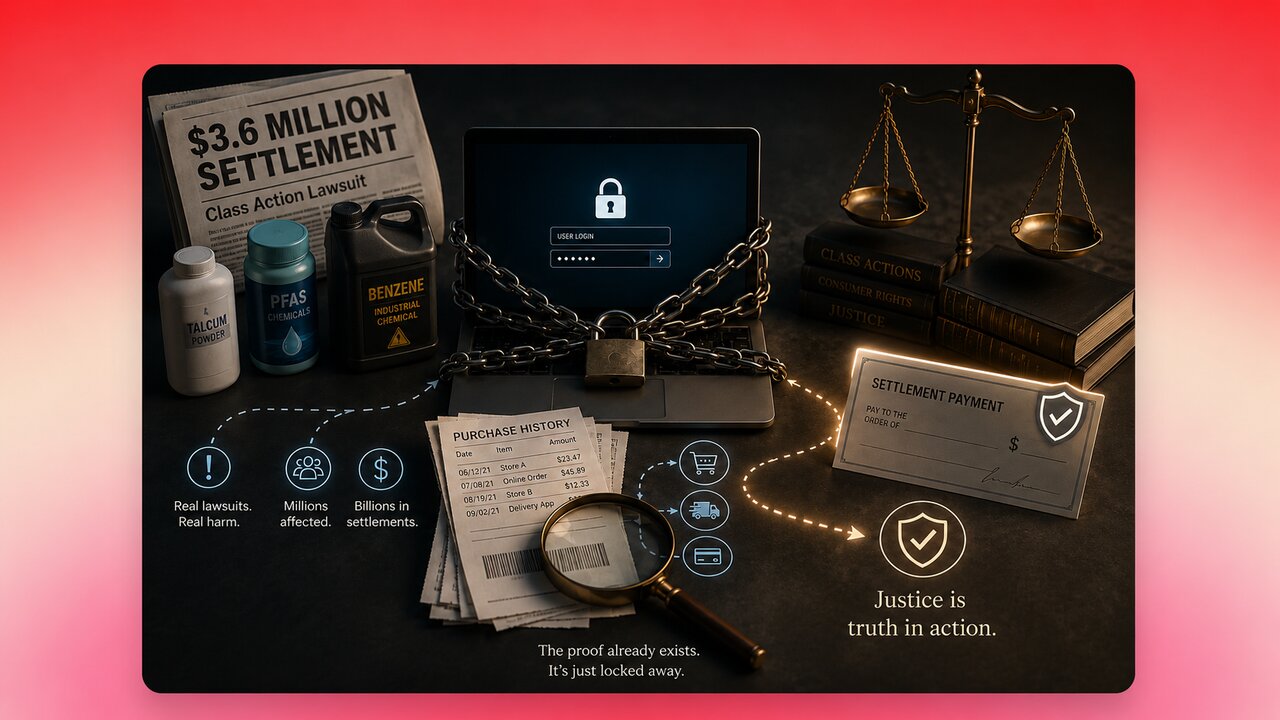
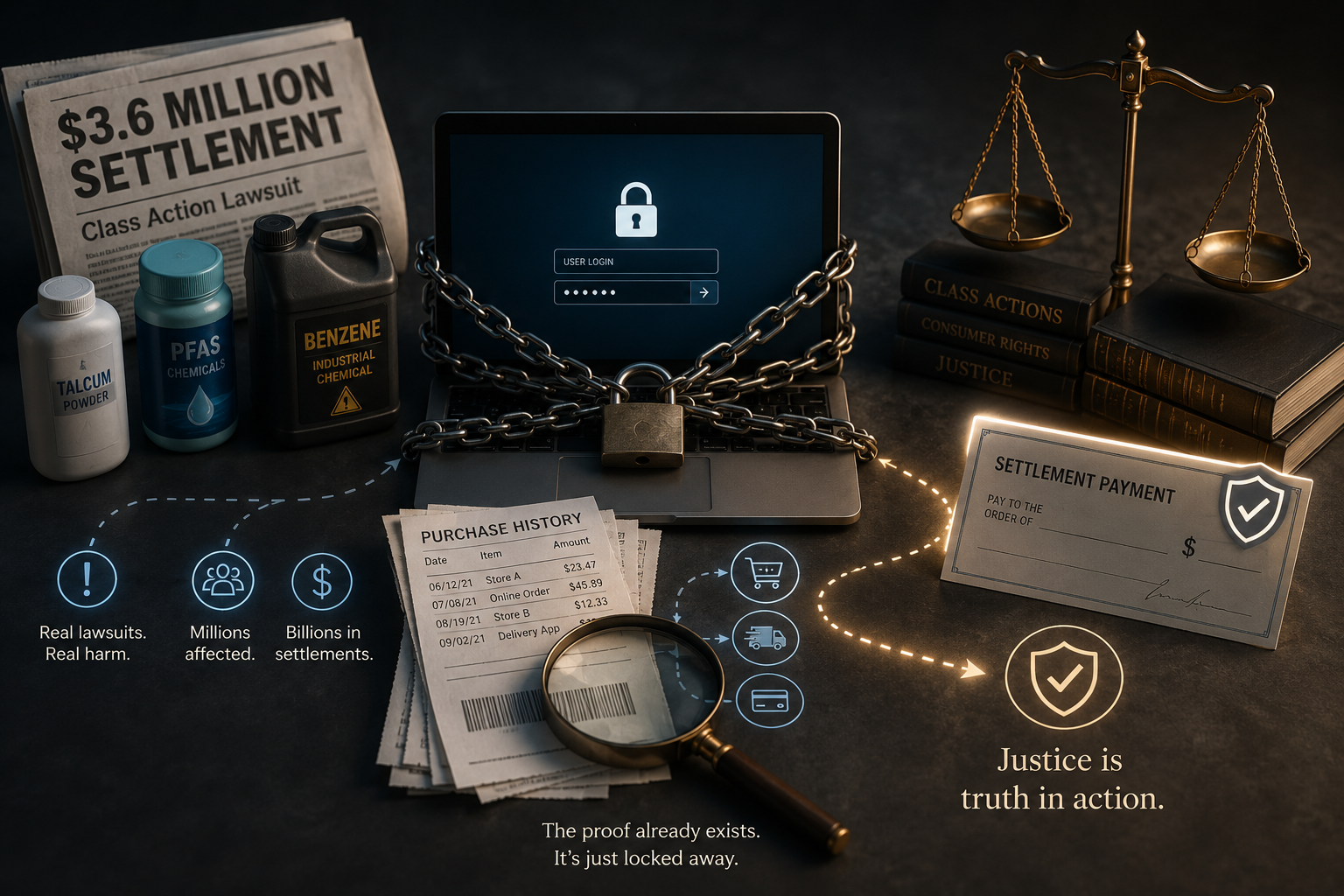
Every year, billions of dollars in class-action settlement money goes unclaimed. Not because the lawsuits are not real. Not because the people affected are not eligible. Because filing the claim requires tracking down a deadline you never heard about, proving a purchase you made three years ago, and navigating a claim form that feels like it was designed to be abandoned.
The pattern is consistent. A headline surfaces — a $3.6 million benzene settlement, a talc contamination case, a PFAS class action — and people see it, recognize they probably used the product, and scroll on. Not because they do not care. Because the effort required to go from "I might be eligible" to "I filed and got paid" is too high for most people to clear.
Previously we shared our experience at the HackPrinceton 2026 x Enter.pro: Building the Future | Enter . That article was about the energy, the mission, the bigger picture. This article is a deep dive in a team who built with Enter during the competition and won a price: Aletheia.
What the team behind Aletheia noticed is that the effort is almost entirely manufactured. The evidence already exists. Purchase histories from major retailers, delivery apps, and payment platforms contain SKU-level records of exactly what people bought, when, and from whom. The data that proves eligibility is already there. It is just sitting on the wrong side of a login.
What Aletheia Does
Aletheia turns purchase history into a filing-ready claim packet in three moves.
Link accounts. Users connect their shopping and delivery accounts, and Aletheia pulls down the transaction data — every product name, merchant, date, and line-item price. Not categories. Actual products.
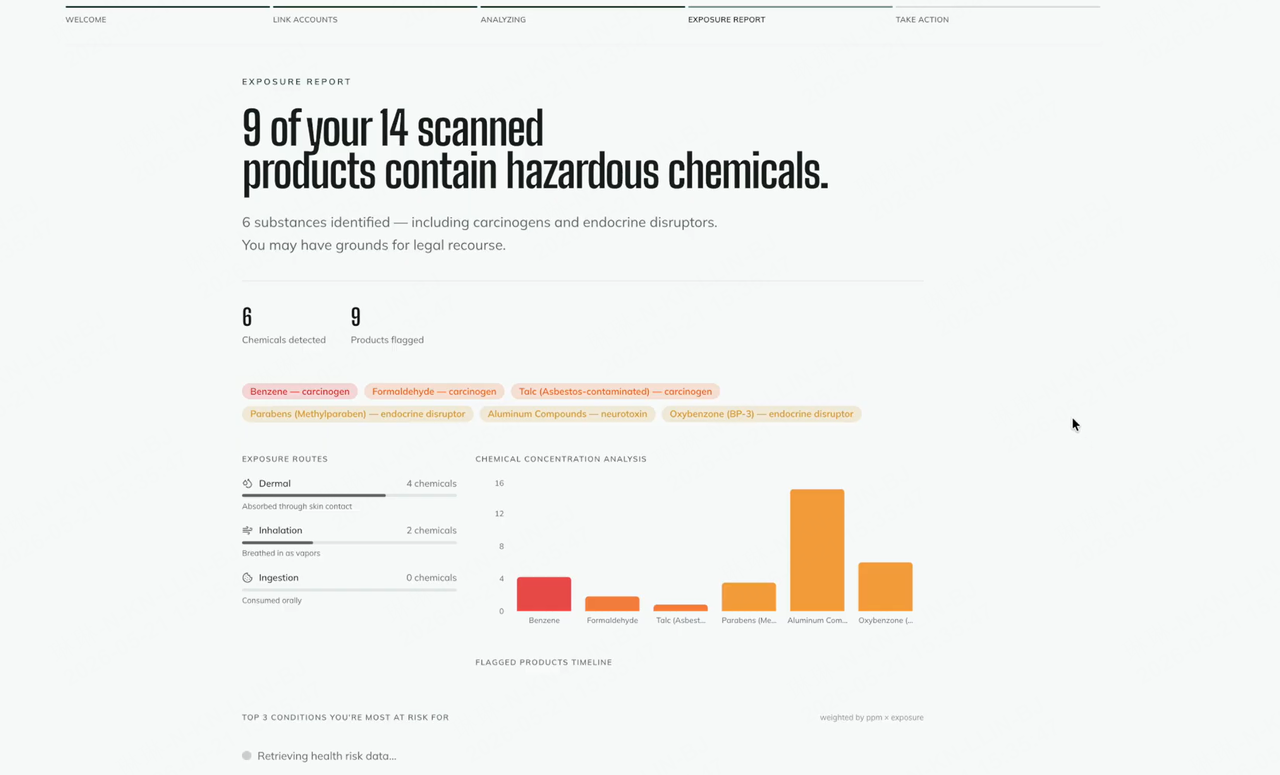
Scan for exposure. An AI-powered analysis cross-references every purchased product against a curated catalog of chemicals linked to litigation: benzene, talc, parabens, PFAS, formaldehyde releasers, and others. Users receive an exposure report with a 0–100 score, a percentile ranking, and a breakdown by chemical and flagged product. It is not a warning. It is a picture of what you have actually been exposed to, based on what you actually bought.
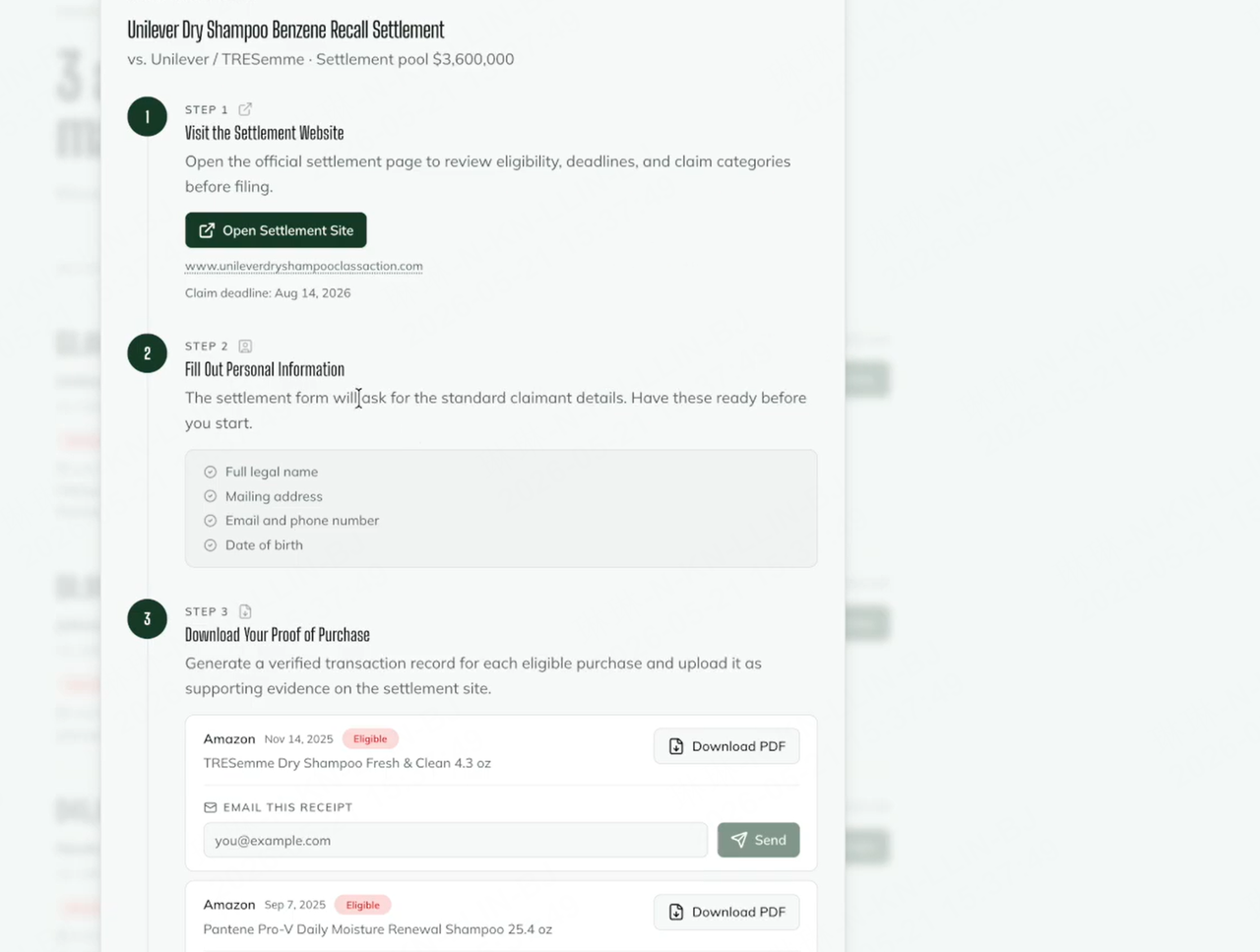
Match to settlements. The detected chemicals and products are matched against a live catalog of active class-action settlements, updated hourly from public legal databases. Each match is classified: either the user bought the specific eligible product, or their exposure overlaps with the chemical at issue. Expired settlements are filtered out. Duplicates are collapsed. For every match, Aletheia generates a five-step filing guide and a PDF evidence packet — built from the purchase records — ready to submit.
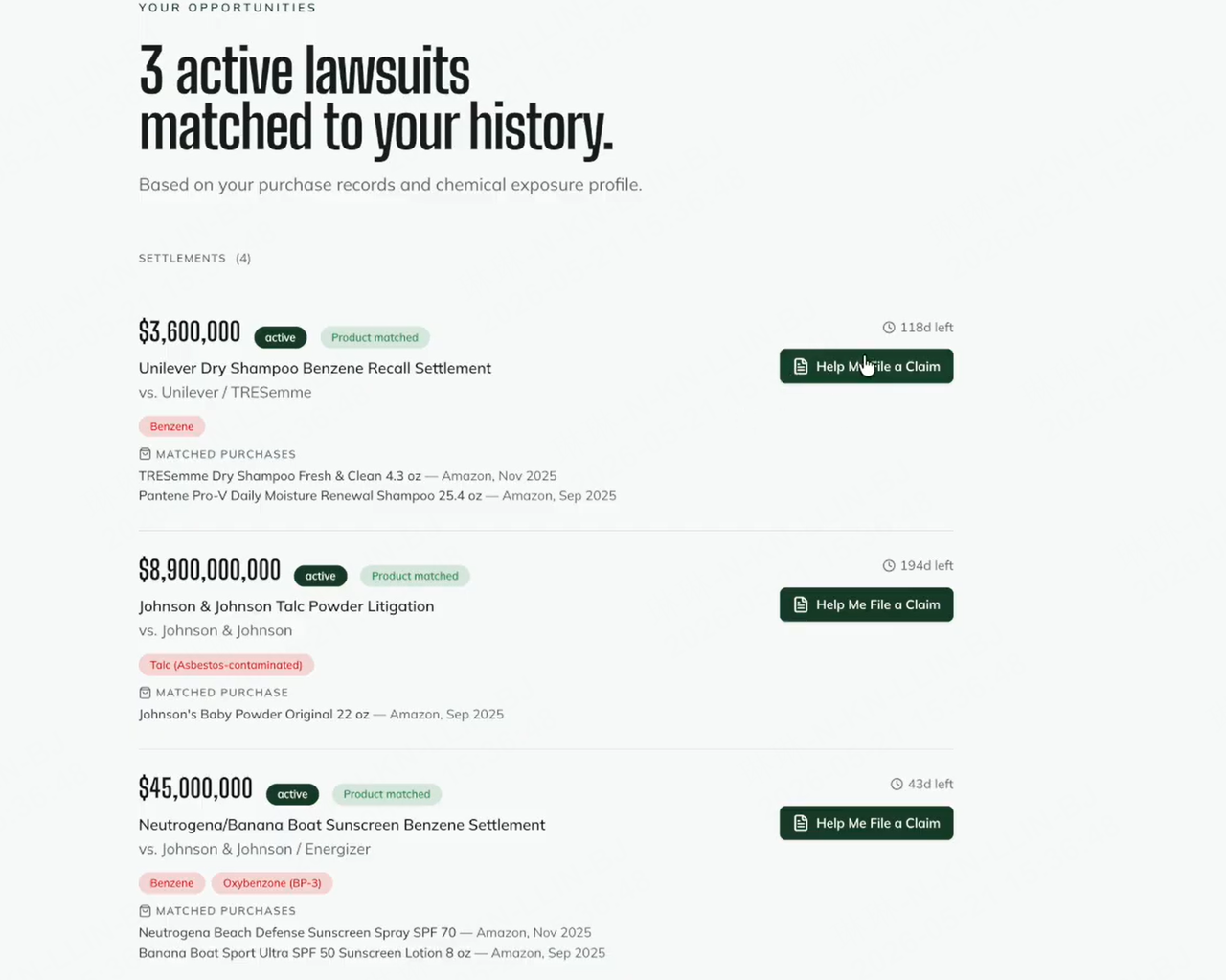
The mismatch Aletheia is closing is not about legal complexity. It is about information and friction. The claim administrators already accept purchase records as evidence. The records already exist. The gap was a tool that could connect them automatically.
The Build — and the Problem It Ran Into
The team built Aletheia at HackPrinceton Spring 2026; and their workflow moved from research to product requirements to Enter — using Enter's MCP integrations and Skills to connect the external data sources and build the intelligence layer — through to a fully deployed product. Enter handled the backend infrastructure: the auth layer, the database, and the edge functions that power the exposure analysis, the settlement scraping, and the matching logic.
The hardest problem was not technical infrastructure. It was trust.
The first version of the exposure and matching logic let the AI synthesize both the settlement catalog and the match scores. It was fast to build and plausible in output — until it was not. The model invented settlement amounts. It generated claims for lawsuits that did not exist. It produced eligibility verdicts that had no basis in any real legal proceeding.
For a consumer finance product, that is not a bug. It is a disqualifying failure. You cannot tell someone they have a claim worth $4,200 if that number came from a model that was filling in gaps rather than reading verified data.
The fix required separating what AI does well from what it cannot be trusted to do alone. Real settlement data is now scraped directly from public legal databases, stored canonically, and enriched with verified payouts, deadlines, and claim URLs. The AI's role at match time is constrained to citing only what is already in the catalog — no synthesis, no extrapolation. The output is grounded because the database is grounded.
Three de-duplication layers handle the fact that the same settlement frequently appears under slightly different URLs and titles across different sources. Deadline logic distinguishes between settlements that are genuinely closed and those with unparseable or pending dates — the former filtered aggressively, the latter treated as still open. The PDF receipt was iterated until it looked like something a claim administrator would actually accept: merchant headers, line-item tables, verification footers.
Every path has a fallback. The demo never hits a broken state.
What They Are Proudest Of
The full pipeline, end to end. A user links their accounts, receives an exposure report, sees their matched settlements, and downloads a filing-ready PDF — all from purchase data they already had, processed in a way they never had to think about.
And the receipt. Getting a generated document to look like legal evidence, not a hackathon output, took iteration. That it did is the detail the team keeps returning to.
What Comes Next
Webhook-driven alerts: notify users the moment a new purchase matches an existing settlement, without requiring a manual rescan. Auto-fill claim forms: pre-populate standard fields from purchase records and exposure data, and submit on the user's behalf where administrators allow it. Historical lookback via bank-statement OCR, which is where the long-tail settlement money lives — claims on products purchased years before any platform started tracking SKUs. And real payout integration: accept settlement funds directly, with a small success fee.
The infrastructure for all of it is already in place. The pipeline that works for active settlements works for any settlement. The evidence retrieval that works for linked accounts works for uploaded statements. The scope of what Aletheia can do expands with each data source it can reach.
The money has always been there. It was the path to it that was missing.
The team behind this built : Haoran Xu | Anish Yenduri | Brian Li | Adarsh Danda
Missed the earlier volumes? → Vol. 1 — Heritage in Pixels → Vol. 2 — Terra Zone AI → Vol. 3: reAgent → Vol. 4: TaleTailor → Vol. 5: LEGR → Vol. 6: PolyPath → Vol. 7: EcoThread