How to create a Real Estate Business with Enter
Terra Zone AI replaces $20,000 land feasibility studies with a 60-second AI-powered analysis. Discover how this tool is transforming real estate development.
In the United States, the average commercial land feasibility study costs between $15,000 and $50,000 — and takes four to six weeks to complete. That is the price of a single yes or no.
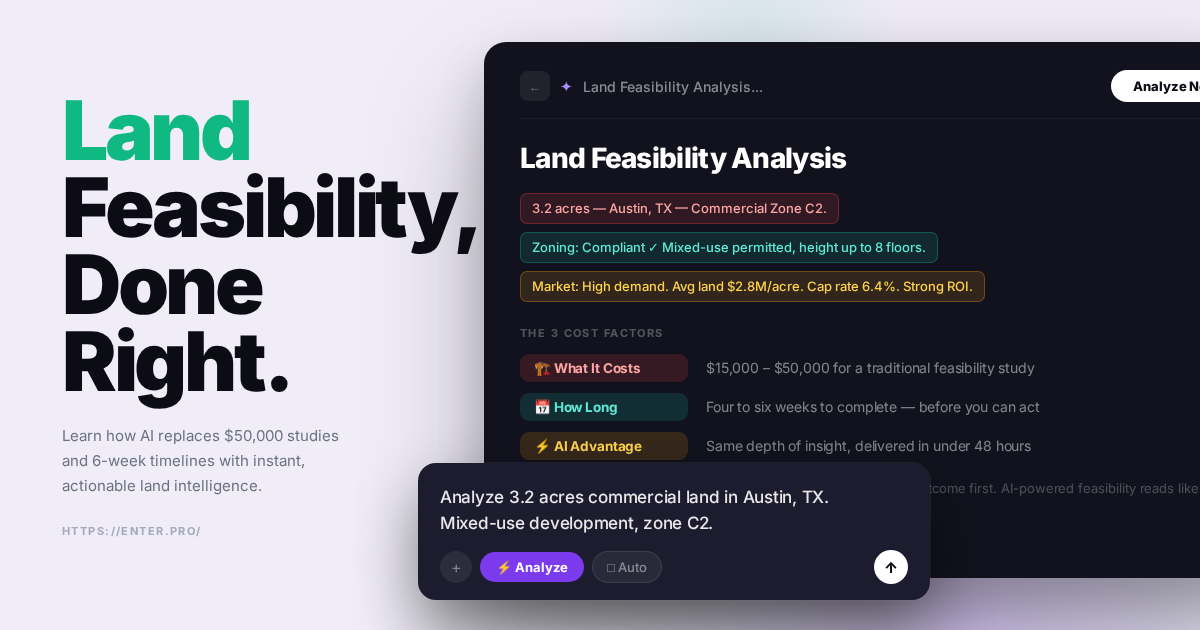
Before a real estate developer can break ground, before a single blueprint is drawn or a dollar of investment committed, they need to know if the land is even buildable. Geological surveys, zoning codes, foundation estimates or soil assessments. Each one pulled manually, by analysts, one dataset at a time.
This is how the civil engineering consulting industry has worked for decades. In 2026, in a world where AI is rewriting software, healthcare, and finance, this specific corner of the economy is still running on spreadsheets and six-week timelines.
At Enter, we believe that anyone with an idea should be able to build it. Not just the people with the biggest teams, the deepest pockets, or the most years of experience. Anyone. That mission brought us to HackPrinceton Spring 2026 — one of the most prestigious student hackathons in the country, held on Princeton's campus. 105 students. 38 projects. 36 hours.
We already wrote about that weekend: the energy in the room, what it told us about the next generation of builders, and why we left more convinced than ever that the future is being built by people most of the world has not heard of yet. You can read that piece: HackPrinceton 2026.
But we made a promise at the end of it. To go back in. One project at a time. To sit with the people behind the buildings. Not just celebrate what they made, but understand why they made it, and what it actually felt like to ship something real in under 36 hours.
This is the second article in that series, and we are diving in their story.
The Moment the Idea Clicked
It started at a university career fair.
One of the Terra Zone AI founders was talking to representatives from an environmental consulting firm; the kind of company that helps developers evaluate raw land before any construction begins. The recruiters described their day-to-day: analysts spending weeks pulling geological surveys, cross-referencing local zoning codes, running foundation estimates. All of it manual. All of it slow. All of it expensive.
The epiphany was immediate.
Generative AI is transforming industry after industry. And yet, here was an entire sector — high-stakes, expensive, deeply consequential — that modern technology had simply passed by. Not because the problem was unsolvable. Because no one had thought of stepping in.
That gap was the idea. And HackPrinceton was the moment to build it.
What They Built
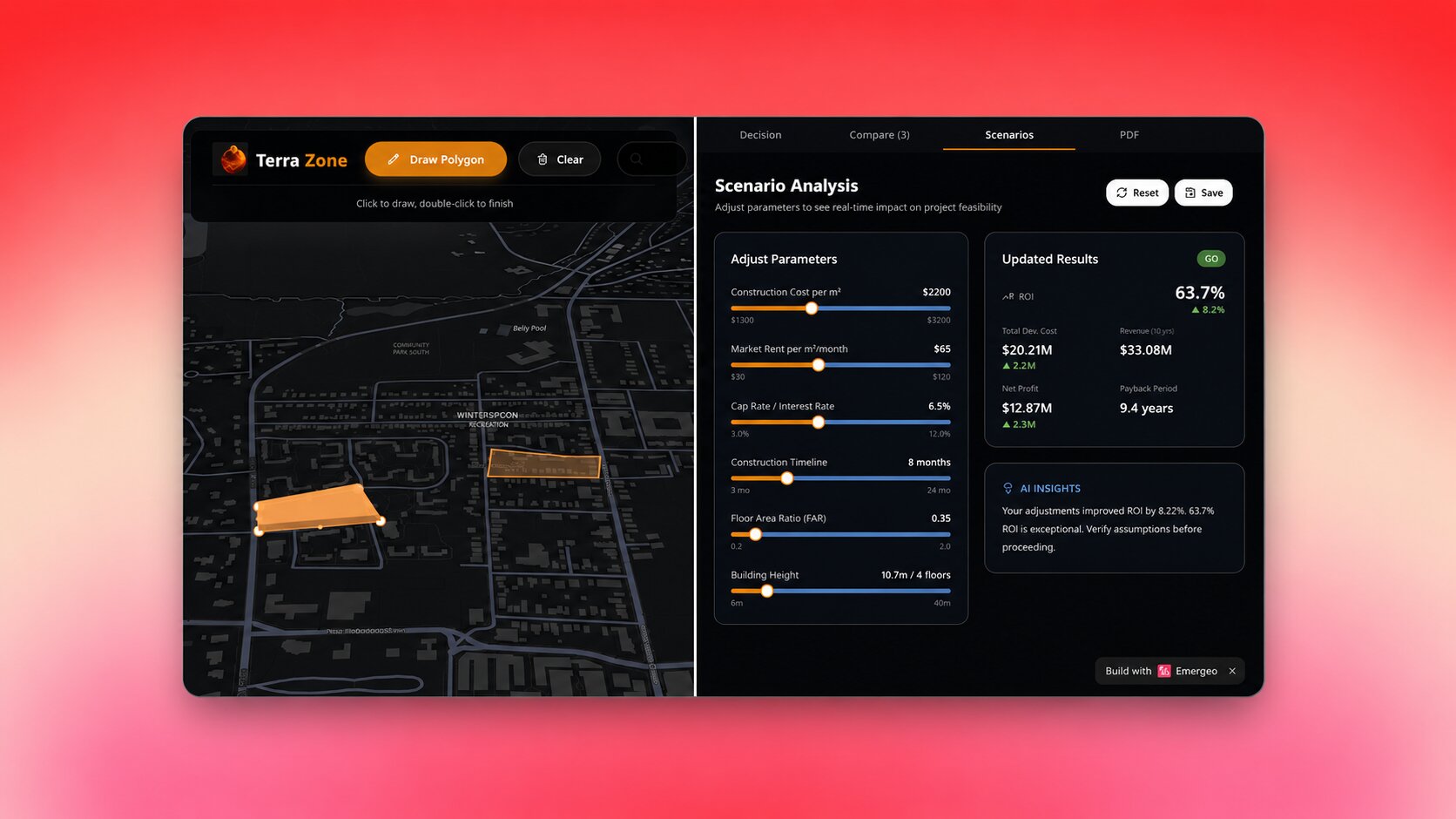
Terra Zone AI is, as the team describes it, "Zillow meets ChatGPT" for real estate developers.

The interaction is disarmingly simple. You open the platform, draw a polygon on an interactive map around the plot of land you want to evaluate, and wait.
In under 60 seconds, the platform pulls together geological data, municipal zoning codes, and construction parameters to produce a full investment-grade feasibility report. It calculates buildable area, models construction risk, and delivers a definitive verdict — GO, NO-GO, or CONDITIONAL — complete with a risk-adjusted financial breakdown and alternative development strategies if the primary path is blocked.
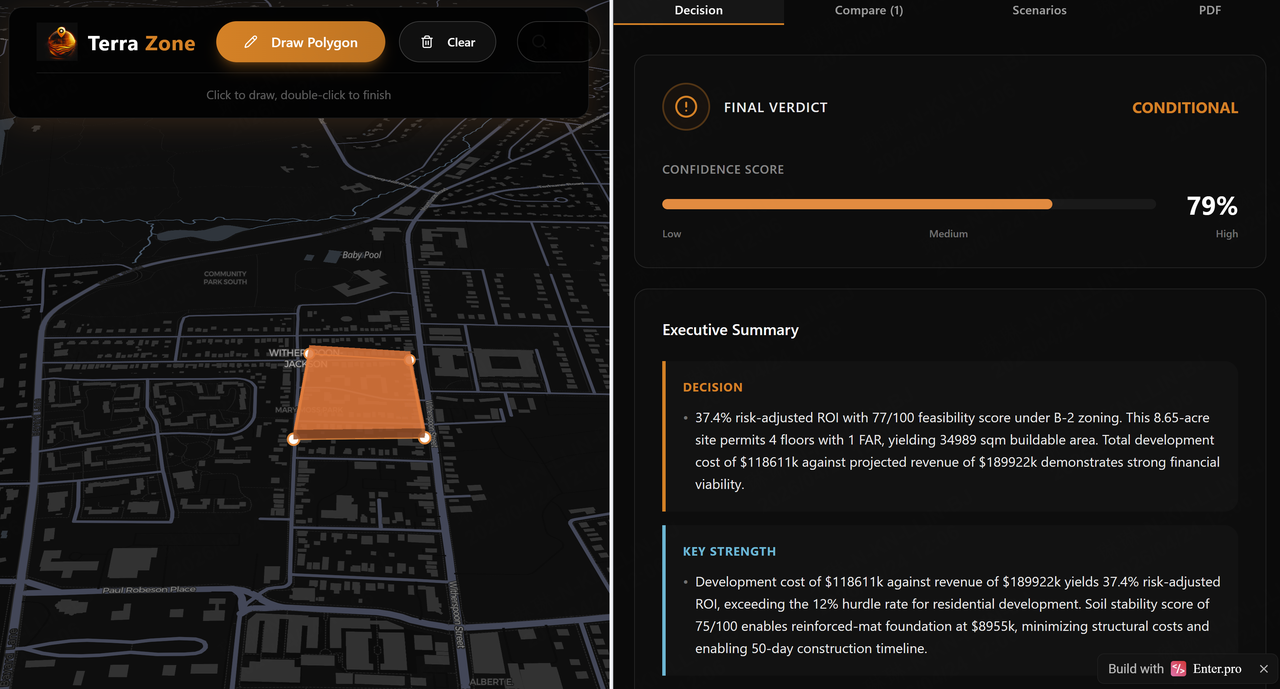
Six weeks of consultant work. One shape drawn on a map. Sixty seconds.
The Engineering Discipline Behind It
What makes Terra Zone AI impressive is not just that it works. It is how it works.
Real-world data is messy. External APIs can fail. AI models occasionally hallucinate. In a high-stakes industry where a developer might be staking millions of dollars on a feasibility verdict, a broken interface or a fabricated metric is not just a bug--it is a liability.
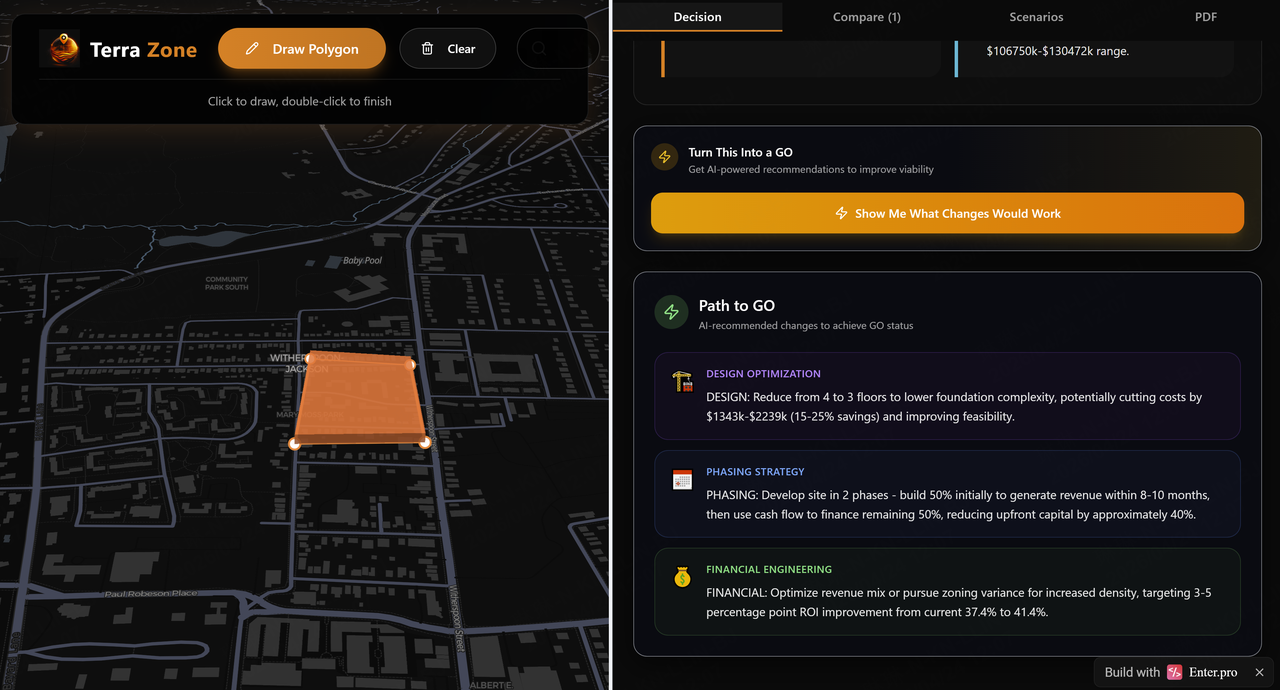
So the team built a seven-layer fallback system. If an external data source fails, the platform falls back to deterministic mathematical calculations. If the AI synthesis misfires, the structured prompts and JSON validation catch it before it reaches the user. The interface never breaks. The verdict is always grounded in real data.
That is not just good engineering for a hackathon. That is product thinking. The kind that comes from genuinely understanding the stakes of the problem you are solving.
They built it with Enter.pro — which gave the team the full technical foundation to ship a production-grade, serverless application in the time most teams spend just setting up their environment. A cross-university collaboration, complex architecture, live product — in 36 hours.
What They Are Proud Of
The verdict mechanism itself. Taking a process that is inherently messy: geological surveys, zoning codes, financial models, AI synthesis; and collapsing it into a single, clean, actionable output. GO. NO-GO. CONDITIONAL.
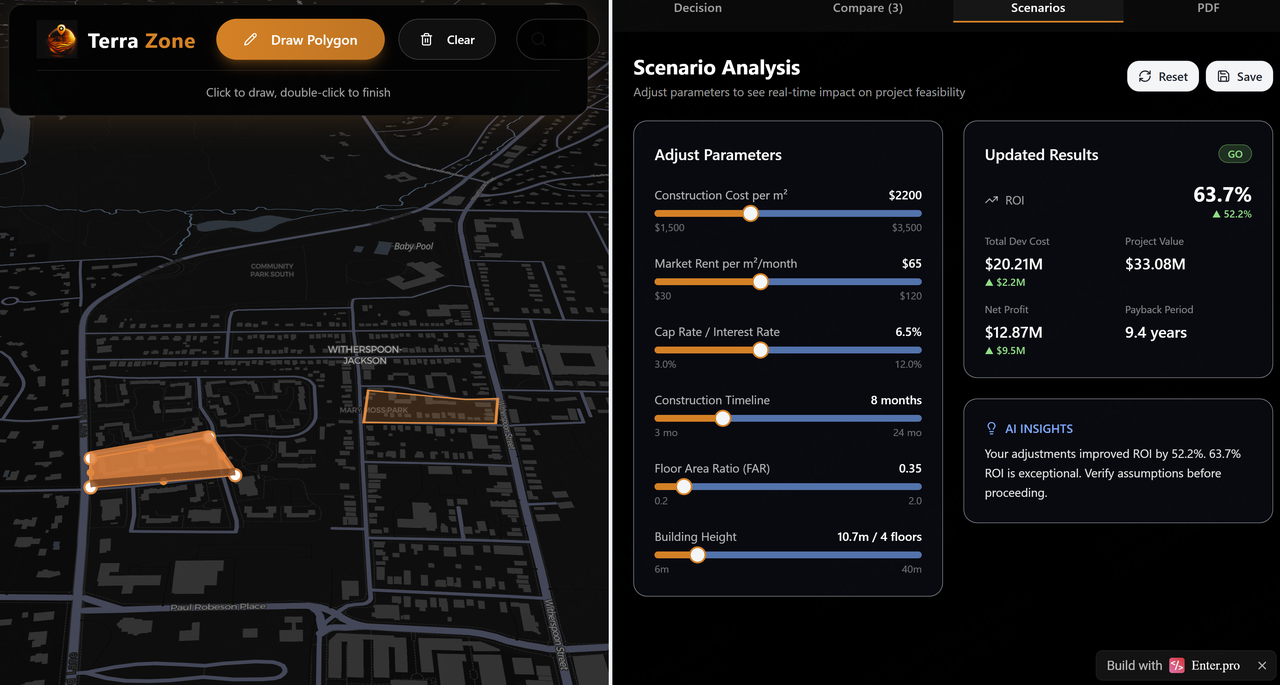
That clarity is hard to engineer. The team is proud they pulled it off.
They are also proud of the fallback architecture — the decision to never let the system show a broken state, no matter what. In an industry where trust is everything and the cost of a wrong answer is enormous, building a platform that degrades gracefully is not a nice-to-have. It is the product.
What Comes Next for Terra Zone AI
Right now, the platform covers Princeton, New Jersey — the city where it was built and the city that validated the concept. The immediate roadmap is a statewide rollout across New Jersey, with a nationwide expansion to follow.
On the technical side: user authentication so developers can save and compare analyses across multiple land plots, FEMA flood zone overlays, and historical permitting data to make the AI verdict even more precise.
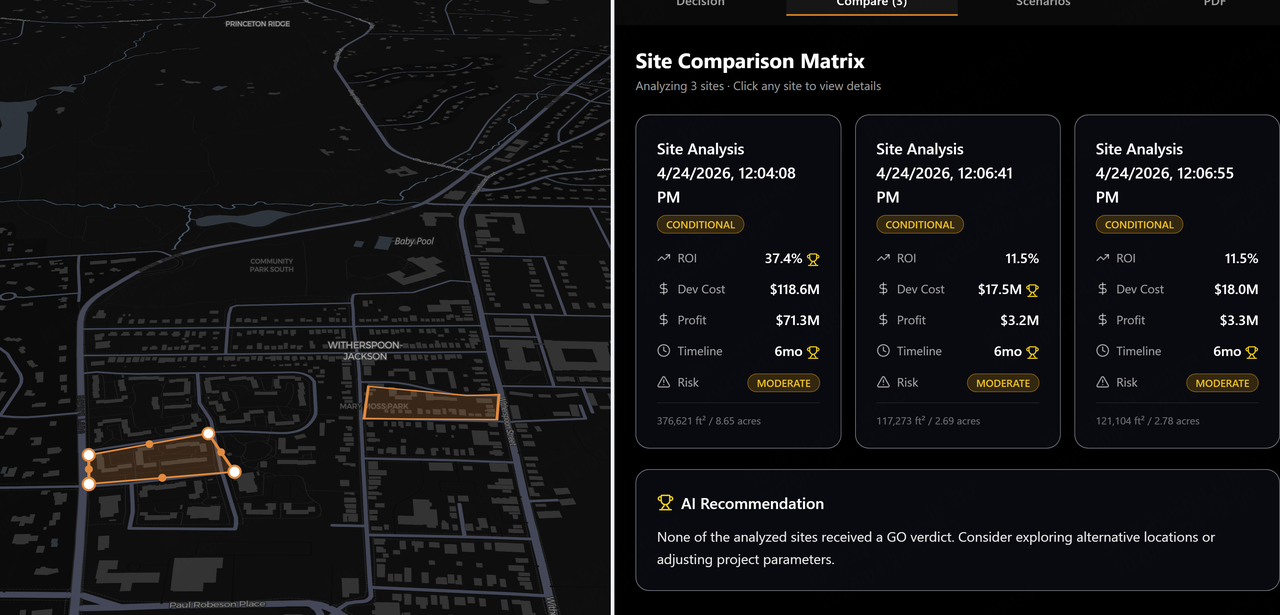
The bigger picture is clear. Every city in America has developers asking the same expensive question. Terra Zone AI is building the infrastructure to answer it — instantly, at scale, for a fraction of the current cost.
What a Career Fair Conversation Became
There is a version of this story where the insight stays in someone's head. Where the person who spotted the gap walks away from the booth, files it somewhere in the back of their mind, and moves on with their day.
That is what usually happens.
At HackPrinceton, it became a product. A live, working platform that compresses six weeks of consulting work into sixty seconds. Built by students who had never competed in a hackathon together, in a problem space neither of them had worked in before.
This is what we built Enter for. Not just to make building easier; but to make sure that the moment an idea is ready, nothing stands in the way of it becoming real.
This is Vol. 2 of our HackPrinceton Builder Series. Vol. 1 featured Heritage in Pixels — an educational game built by three first-generation Vietnamese students to tell a story that history classes haven't.
Explore Terra Zone AI: Terra Zone Project