How to create an AI learning platform
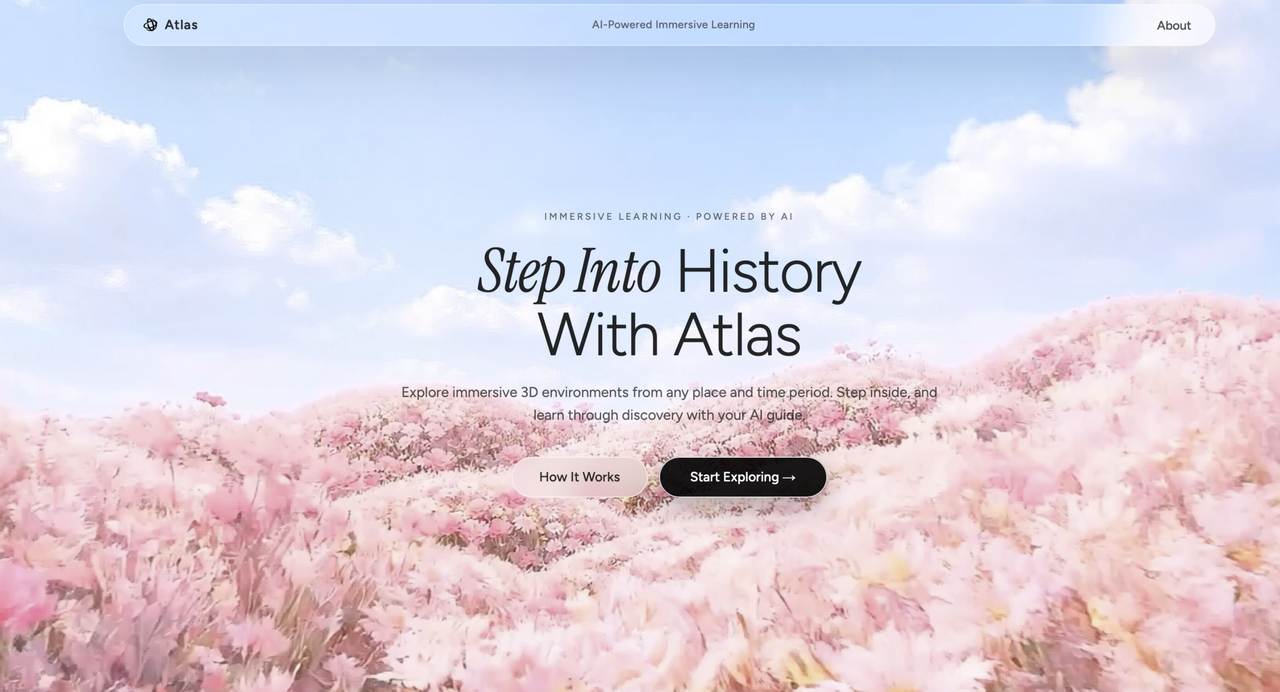
Atlas lets you step inside history and science concepts via AI-generated 3D worlds. Explore immersive education with a real-time AI Guide. Discover the future of learning.
Enter was at HackPrinceton Spring 2026 — 410 participants, 36 hours, on Princeton's campus. We were there to support the next generation of builders. The team behind Atlas was one of the ones we kept coming back to.
The Problem With How We Teach
There is a gap at the center of most education that everyone who has sat through a history class already knows.
You are told what happened. You read the words. You take the test. And somewhere between the textbook and the exam, the thing that was supposed to matter — the moment, the place, the reality of it — never quite lands. It stays abstract. Words on a page describing a world you cannot see.
The same is true for science. Photosynthesis is a word before it is a process. The steps get memorized. The understanding, the intuition for what is actually happening inside a leaf when light hits it — that takes something more than a diagram.
The team behind Atlas started with a simple observation: the tools to change this now exist. Immersive 3D environments, AI that can speak and reason in real time, world generation from a single text prompt. The question was whether those tools could be assembled into something that felt less like a product and more like a place.
What Atlas Actually Is
Type any historical event or scientific concept. Step inside a generated 3D world built around it.
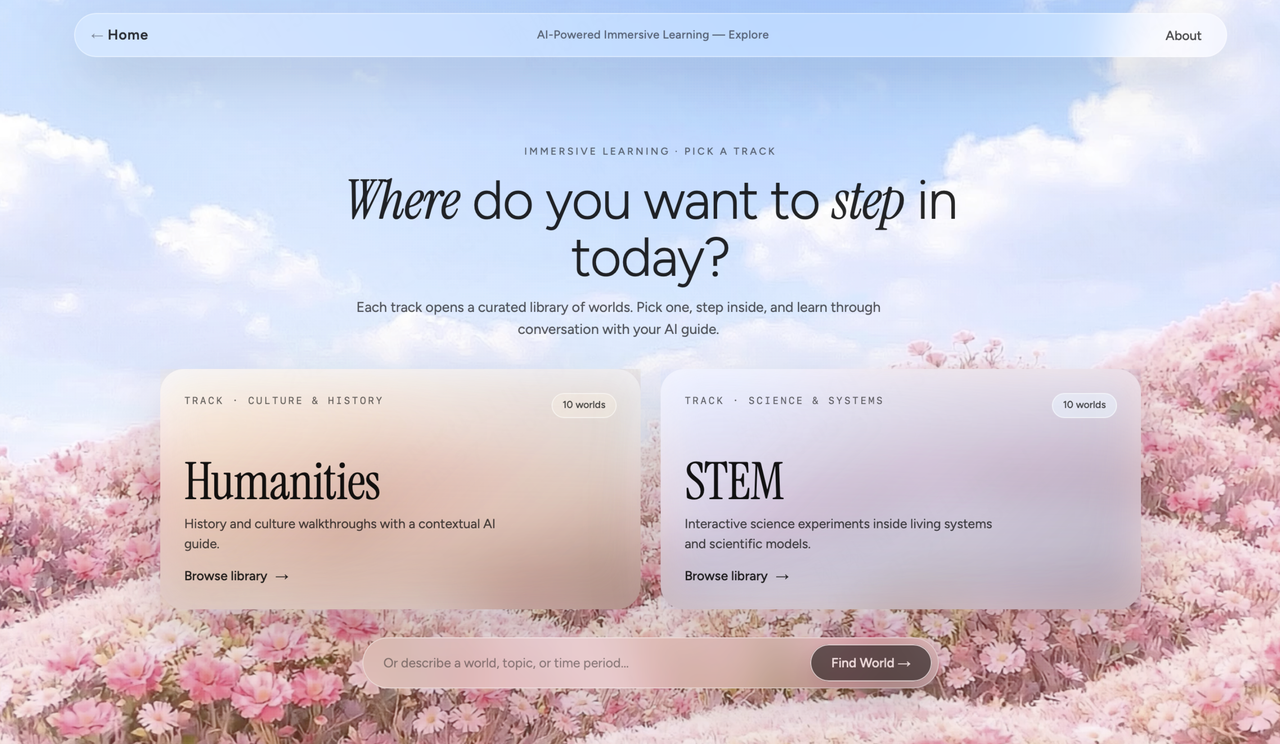
That is the core of Atlas — and the description undersells what it actually feels like to use it. The world is not an illustration or a simulation in the traditional sense. It is a photorealistic environment generated from your prompt, rendered in real time, and built around the specific thing you came to understand.
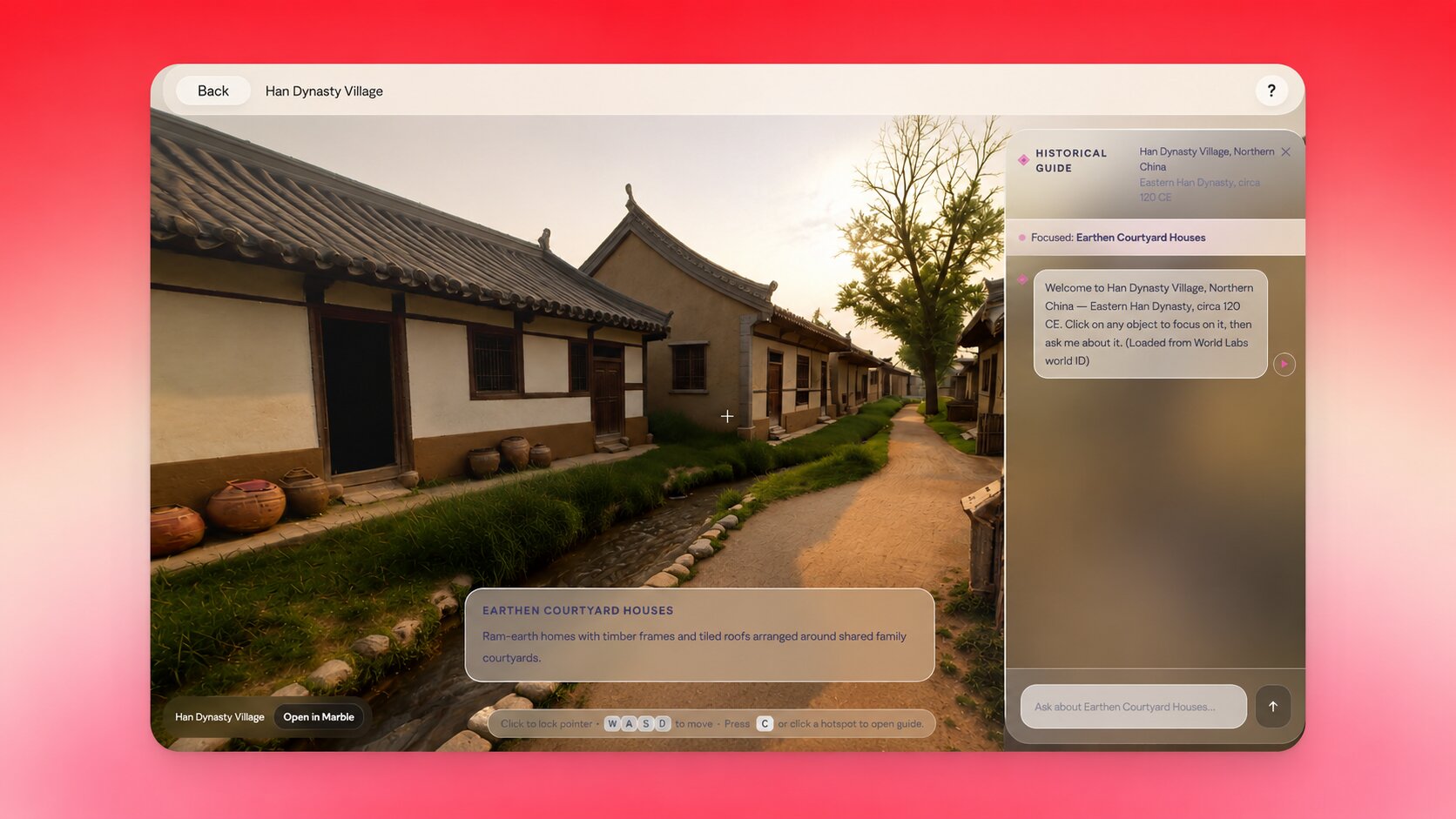
Inside that world is an AI Guide. It speaks. It listens. It answers questions the way a knowledgeable person standing next to you in that environment would — grounded in the scene around you, in the objects you can see, in the specific context of where you are and what you are looking at. You can click on individual elements and ask about them directly. For science scenes, guided experiments respond to your actions. A photosynthesis cycle that changes as you interact with it. A world that teaches by doing, not by telling.
Atlas's interface showing a generated 3D environment of an Ancient Chinese village, with the AI Guide active in the corner — ready to answer questions grounded in the objects and spatial context visible in the scene.
The Hard Problem They Solved
The most interesting technical challenge Atlas ran into was also the most fundamental one: keeping the AI Guide honest about what was actually there.
A language model, given free rein inside a world it cannot see, will fill in gaps. It will describe people who are not present, reference objects that were never generated, add context that feels right but is not grounded in the actual environment the student is standing in. For a history lesson, that kind of hallucination is not just inaccurate — it actively undermines the thing Atlas is trying to do.
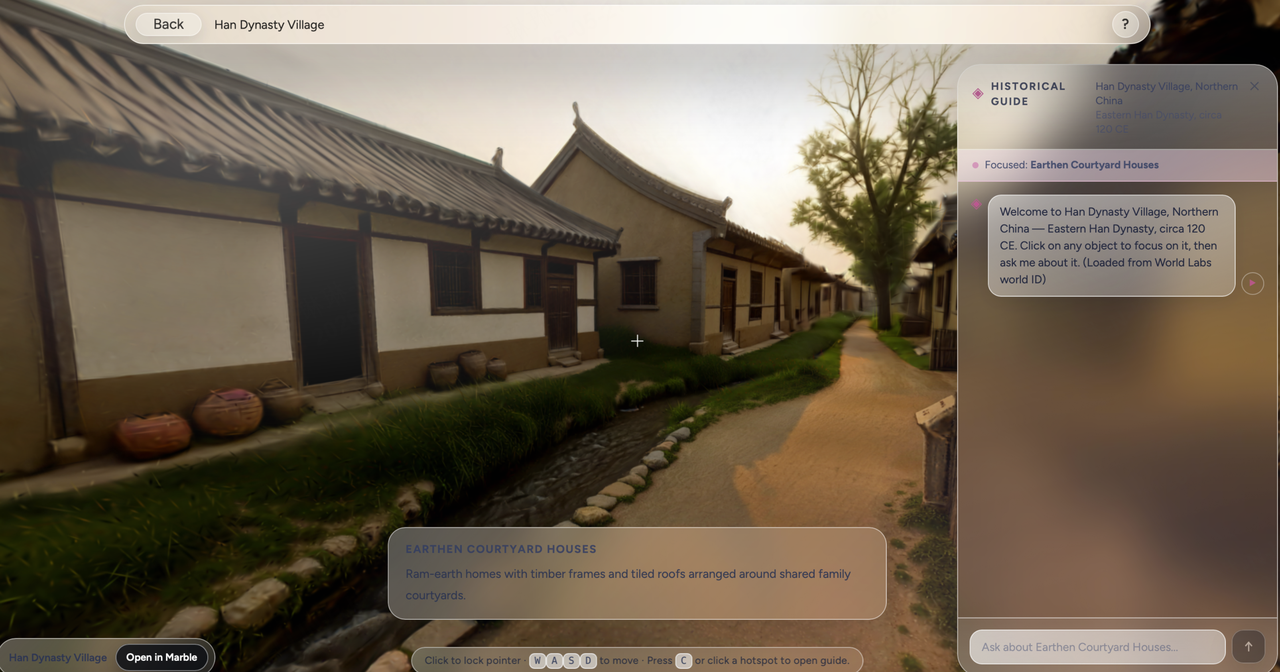
The solution was a scene graph system — a structured representation of every labeled, queryable element inside the generated world. Before the Guide answers anything, it reads the scene. It knows what is there. Every response is anchored to that spatial and historical context, not to the model's general knowledge of what an Ancient Chinese village might look like.
The result is an AI that behaves less like a search engine and more like a guide who has also been standing in that room.
The scene graph architecture behind Atlas structures each generated world into labeled, queryable elements — giving the AI Guide spatial grounding so every answer reflects what the student can actually see.
What They Are Proudest Of
The full loop working end to end.
Type a prompt. A real 3D world generates around it. A voice-enabled AI Guide answers questions from inside that world with historically accurate, spatially grounded detail. For a team building at a hackathon — assembling a pipeline that spans world generation, 3D rendering, scene interpretation, conversational AI, and voice synthesis — getting that loop to close cleanly in 36 hours is the accomplishment.
The STEM experiment mode stood out even to the team themselves. Teaching science through interaction rather than instruction changes the relationship between the student and the concept. You are not memorizing the steps of photosynthesis. You are watching it respond to what you do. That distinction matters more than it might sound.
What Comes Next
The world generation quality is the clearest area for improvement — Gaussian Splatting creates photorealistic environments, but the current resolution has limits, and the team wants to expand both the fidelity and the scale of what gets generated from a single prompt.
The bigger ambition is VR. A 3D world on a screen is one thing. Standing inside it, moving through it with your body, reaching toward an object to ask about it — that is the version of Atlas that closes the gap between learning and experiencing entirely.
The Bigger Idea
Education has always had the right intention. The tools to match that intention have lagged.
What Atlas represents is the beginning of a genuinely different model — one where the environment does the teaching, where questions get answered in context, where the distance between a concept and a felt understanding of it collapses. The technology to build this existed in pieces for years. What changed is the ability to assemble those pieces into something a student can actually walk into.
That is the kind of problem worth spending 36 hours on. And the kind of answer that takes longer than 36 hours to finish.
Missed the earlier volumes? → Vol. 1 — Heritage in Pixels → Vol. 2 — Terra Zone AI → Vol. 3 — reAgent → Vol. 4 — TaleTailor → Vol. 5 — LEGR → Vol. 6 — PolyPath → Vol. 7 — EcoThread→ Vol. 8 — Aletheia → Vol. 9 — Synova → Vol. 10 —** Overturn Insurance→Vol. 11 — VentureLink**