
What Is Composable Commerce and Why Businesses Are Adopting It
Discover what composable commerce is and how it empowers businesses with modular, flexible architecture. Learn the meaning, requirements, and how composable commerce works for modern digital success. Explore how Enter Pro helps you build faster.
Businesses today need flexible ecommerce solutions that can quickly adapt to changing customer expectations and digital trends. Traditional ecommerce platforms often limit customization and scalability, making innovation more difficult. Composable commerce solves this challenge by allowing businesses to build customized commerce ecosystems using independent and modular technologies. This modern approach helps brands improve agility, deliver better customer experiences, and scale operations efficiently. As ecommerce continues to evolve across multiple digital channels, composable commerce has become an important strategy for businesses seeking long term growth and flexibility.
What is composable commerce?
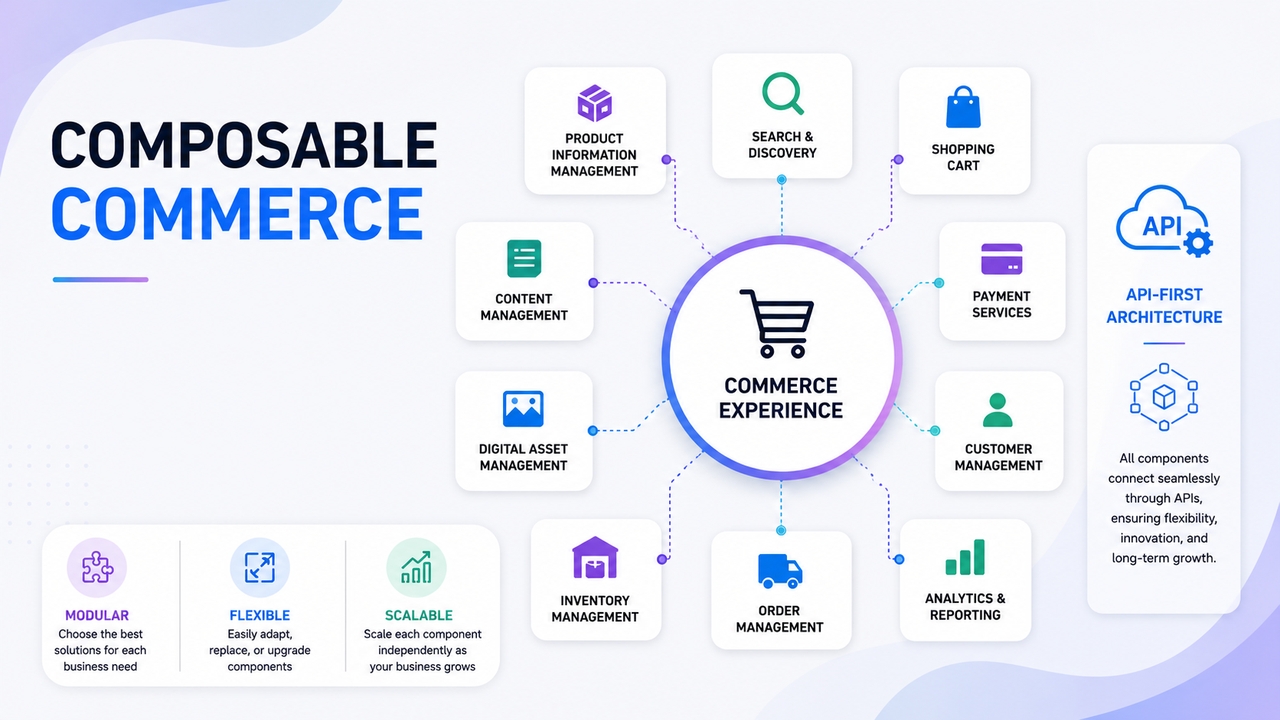
Composable commerce is a modern ecommerce approach that allows businesses to build digital commerce systems using independent and modular technologies. Instead of relying on a single platform with fixed capabilities, businesses can select specialized tools for payments, product management, search, checkout, and customer engagement. These technologies work together through APIs, creating a flexible and scalable commerce ecosystem. The composable commerce definition focuses on adaptability, faster innovation, and improved customer experience. Businesses can update or replace individual components without disrupting the entire system, making composable commerce an effective solution for brands seeking long term digital growth and operational flexibility.
How composable commerce works
Understanding how composable commerce works requires looking at both its architecture and its underlying principles.
The architecture
At its core, composable commerce breaks the traditional monolithic platform into discrete, API-connected modules. Each module is a Packaged Business Capability (PBC): a self-contained service that covers a specific commerce function. Common modules include product information management (PIM), order management systems (OMS), digital asset management (DAM), payment processors, search engines, and content management systems (CMS).
These modules communicate through APIs, meaning changes to one component do not cascade into breaking changes across the entire system. A business can upgrade its search functionality, replace its payment gateway, or add a new sales channel without rebuilding its entire platform from scratch.
Three core principles
Composable commerce operates under three guiding principles that define how the architecture delivers value:
Business-centric solutions: Every component is chosen based on what best serves the specific needs of the business, not what comes bundled with a platform license. This puts commercial outcomes at the center of technology decisions.
Modular architecture: The use of microservices and independently deployable components means the system can evolve incrementally. Teams can experiment, iterate, and scale without system-wide risk.
Open ecosystem: Rather than being tied to one vendor's integrations, composable systems thrive on open APIs and a broad marketplace of compatible tools. This creates flexibility and reduces long-term vendor dependency.
Composable commerce vs. Traditional monolithic commerce
To fully appreciate the composable commerce meaning, it helps to contrast it with the traditional approach it replaces.
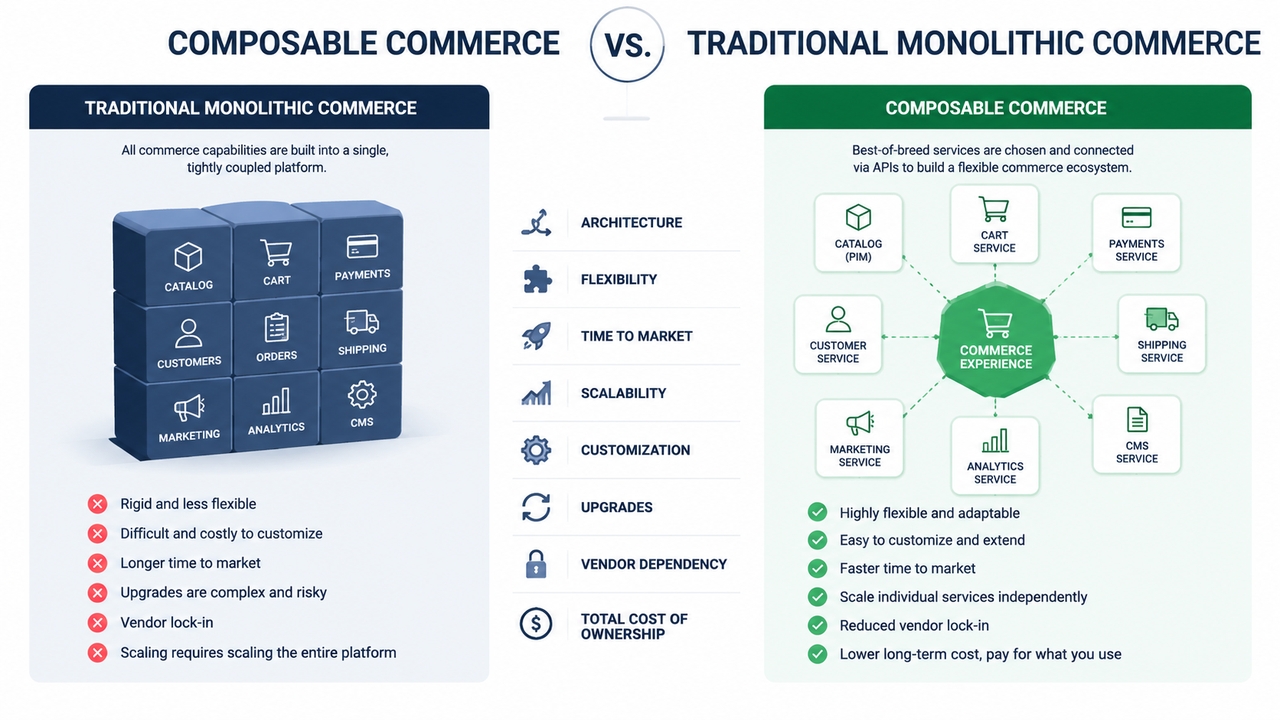
A monolithic commerce platform offers a single, all-in-one solution from a single vendor. Everything, from storefront templates to inventory logic, lives within one codebase. For many years, this model worked well, providing a standardized experience with manageable complexity.
The limitations emerged as the digital landscape expanded. Massive monolithic codebases made plug-and-play replacement of outdated technology nearly impossible. Extensive knowledge of the codebase was required for even minor adjustments, and scalability was severely limited. As a result, development speed and time-to-market lagged far behind the pace of modern commerce.
Composable commerce addresses these limitations directly. Where monolithic systems require rebuilding entire sections to accommodate change, composable systems allow individual components to be swapped out without touching the rest of the stack. Where monolithic platforms lock brands into a single vendor's feature roadmap, composable architecture gives teams the freedom to adopt the best available technology at any time.
Headless commerce vs Composable commerce
Headless commerce and composable commerce are closely related, but they are not the same concept.
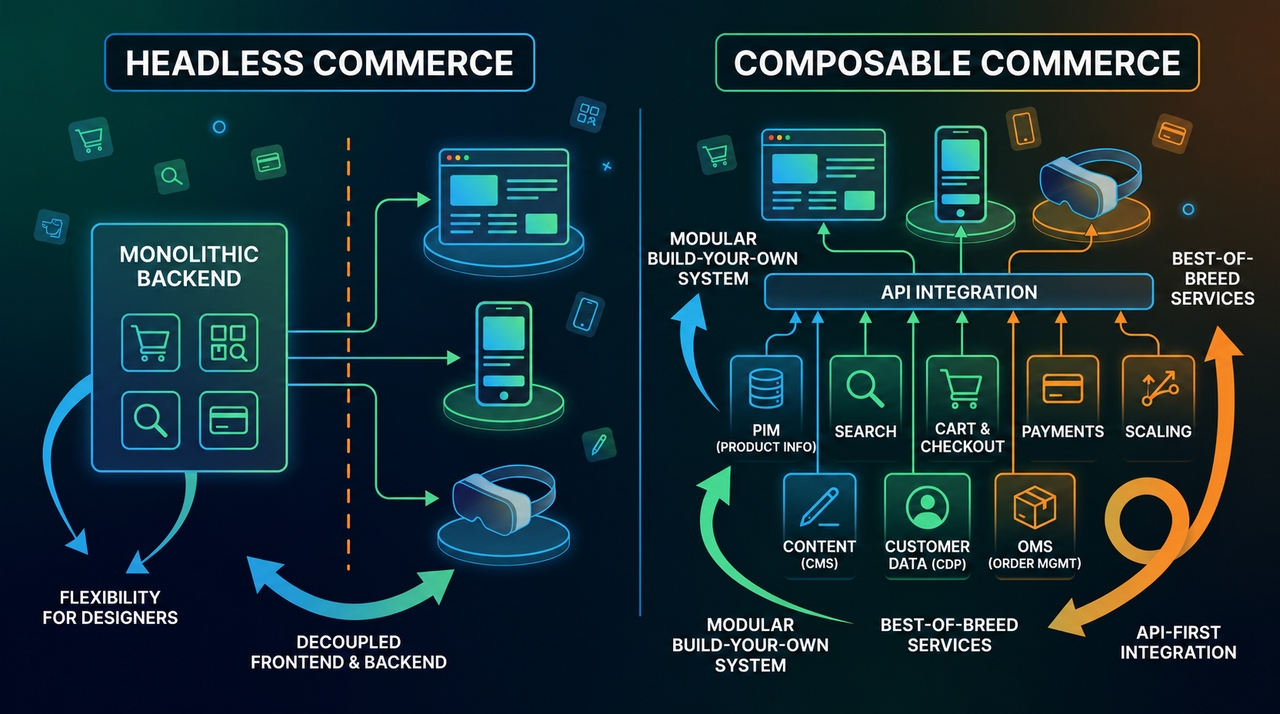
Headless commerce separates the frontend presentation layer from the backend commerce system. This allows businesses to create customized customer experiences across websites, mobile applications, and other digital channels while maintaining a centralized backend.
Composable commerce goes beyond headless architecture by allowing businesses to combine multiple independent backend services alongside frontend flexibility. Businesses can choose separate solutions for checkout, product management, search, payments, and customer engagement.
In simple terms, headless commerce focuses on frontend flexibility, while composable commerce focuses on building an entire modular commerce ecosystem.
Key requirements for composable commerce
Adopting composable commerce successfully requires more than selecting new software. There are fundamental composable commerce requirements that organizations should evaluate before and during implementation.
- API-first infrastructure: Every component in the stack must expose and consume APIs reliably. This is the foundation that allows modules to communicate and interoperate seamlessly.
- Clear organizational alignment: Composable architecture requires cross-functional collaboration between technology, marketing, and commerce teams. Decisions about which components to adopt, integrate, and replace must align with both technical and business priorities.
- Strong integration and orchestration capability: With more vendors and services in play, the ability to manage data flows, event triggers, and service dependencies becomes critical. Middleware, integration platforms, or custom orchestration layers often play a key role.
- Robust product data management: Rich, accurate, and channel-ready product data is essential for composable commerce to deliver consistent experiences across every touchpoint. A strong PIM or product data platform becomes a core pillar of the stack.
- A phased migration approach: Most organizations do not replace their entire platform overnight. Successful composable commerce adoption typically involves identifying high-priority pain points, decoupling those specific capabilities first, and expanding over time.
- Ongoing governance and vendor management: With multiple best-of-breed vendors in the ecosystem, maintaining clear ownership, SLA expectations, and integration standards prevents fragmentation and technical debt.
Benefits of composable commerce
The business case for composable commerce is grounded in tangible operational and commercial advantages.
- Agility and speed to market
Because individual components can be updated or replaced independently, teams can launch new features, channels, and experiences far faster than a monolithic platform allows. There is no need to wait on a vendor's product roadmap or navigate a complex monolithic codebase to make targeted improvements.

- True omnichannel capability
Mobile apps, web storefronts, social commerce, voice search, in-store kiosks, and emerging channels all become more accessible when the underlying architecture is built for flexibility. Composable systems allow brands to activate product information and commerce capabilities across every touchpoint without rebuilding the stack for each new channel.
- Reduced vendor risk
With a composable approach, no single vendor holds the entire commerce operation hostage. If a component underperforms, becomes obsolete, or raises its prices, it can be replaced without disrupting the rest of the ecosystem.
- Lower long-term operating costs
By using best-of-breed tools for each function and eliminating redundant capabilities bundled into all-in-one platforms, organizations reduce waste in their technology spend. Internal teams also spend less time working around platform limitations and more time driving commercial outcomes.

- AI readiness
As artificial intelligence becomes a core driver of commerce personalization, dynamic pricing, intelligent search, and agentic workflows, composable architecture provides the modular, API-first foundation AI systems require. With siloed data broken down and services communicating fluidly, AI algorithms can access the rich, unified product and customer data they need to perform effectively.
Composable commerce platforms: What to look for
The market for composable commerce platforms has grown significantly, with vendors offering purpose-built solutions across every layer of the stack. When evaluating platforms, the following criteria matter most.
- MACH-certified components: The MACH Alliance (Microservices, API-first, Cloud-native SaaS, Headless) provides a certification framework that validates whether a platform genuinely supports composable principles. MACH-certified tools are built to integrate cleanly into composable stacks.
- Breadth of native integrations: Platforms with large integration marketplaces reduce the custom development required to connect components, accelerating time-to-value.
- Cloud-native scalability: Commerce traffic is rarely predictable. Cloud-native SaaS components scale automatically to handle peak demand without manual infrastructure management.
- Strong developer experience: Because composable commerce involves assembling and maintaining multiple services, the quality of APIs, documentation, and developer tooling directly affects implementation speed and maintainability.
- Support for headless front-ends: Leading composable platforms provide APIs and SDKs that work with React, Next.js, and other modern front-end frameworks, enabling high-performance, flexible storefronts.
Notable platforms operating in the composable commerce space include commercetools, Adobe Commerce, Salesforce Commerce Cloud, and a growing ecosystem of specialized PIM, OMS, and CMS providers built on MACH principles.
Meet Enter Pro: Accelerating composable commerce with clicks
One of the biggest challenges in composable commerce is the development overhead of building and managing multiple independent components simultaneously. Enter Pro addresses this directly addresses this directly through AI-powered development and vibe coding capabilities designed for modern commerce teams.
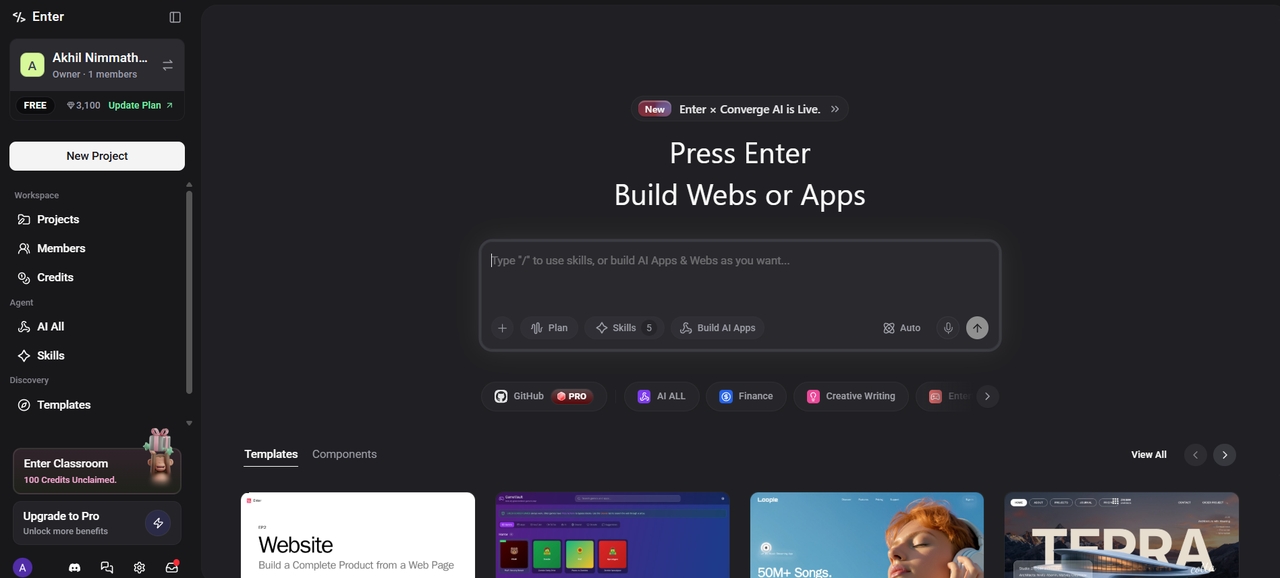
As an AI-powered builder, it lets composable commerce teams prototype storefronts, scaffold new channel interfaces, and generate modular UI components in minutes rather than days. Teams simply describe what they need in plain language and receive production-ready, fully exportable code that integrates cleanly into any composable stack.
Key features
- Rapid prototyping & component generation: Generate modular UI components, storefronts, and new channel interfaces in minutes by simply describing your requirements in plain English. This dramatically speeds up development cycles in composable setups.
- Production-ready exportable code: Receive clean, well-structured, and fully exportable code that can be directly integrated into any existing composable commerce stack without rework or compatibility issues.
- Native integrations: Easily connect with essential tools like databases, payment gateways, CRMs, and analytics platforms using simple prompts, enabling smooth assembly of your modular commerce architecture.
- No vendor lock-in: Maintain complete ownership of all generated code and components, giving you full freedom to use, modify, and deploy them across any platform or future tech stack.
Conclusion
Composable commerce is changing how businesses build and manage digital commerce experiences. Its modular approach allows organizations to select the best technologies for their specific goals while improving flexibility, scalability, and customer experience.
As ecommerce continues to evolve, composable commerce provides businesses with the agility needed to remain competitive in dynamic digital markets. By combining the right technologies, platforms, and AI powered solutions such as Enter Pro, organizations can create future-ready commerce ecosystems that support long term growth, operational efficiency, and personalized customer experiences.
FAQs
Is composable commerce expensive to implement?
Composable commerce can require higher initial investment because businesses choose multiple specialized technologies. However, it often reduces long-term costs by improving flexibility, scalability, and operational efficiency while avoiding complete platform replacements in the future.
Which industries benefit most from composable commerce?
Retail, fashion, healthcare, manufacturing, and B2B ecommerce businesses benefit significantly from composable commerce because these industries often require personalized customer experiences, rapid innovation, and support for multiple digital sales channels.
How secure is composable commerce?
Composable commerce can provide strong security when businesses use trusted cloud based providers and maintain proper API management, authentication, and data protection practices across all integrated technologies within the ecosystem.
How do companies migrate to a composable system?
Companies typically use a phased migration method known as the strangler pattern. Instead of a risky complete overhaul, brands systematically break down their legacy monolith and replace individual functionalities with modular microservices one step at a time.
What are the technical requirements for adoption?
Adopting this framework requires high digital maturity, skilled engineering teams, robust API gateways, and centralized data pipelines. Businesses must also adapt to managing multiple distinct service level agreements instead of relying on one single software provider.