Flutter vs React Native: Which One Makes Sense in 2026?
Flutter vs React Native in 2026: An expert guide to architecture, performance benchmarks, and ecosystem scaling. Discover how Enter Pro eliminates setup friction to launch high-performance cross-platform mobile apps faster.
Flutter vs. React Native remains a hot topic in 2026, as companies strive for fast development, scalable architecture, and superior mobile performance. Flutter is known for its UI consistency and efficient rendering, whereas React Native is popular among developers for its fast development pace and use of JavaScript.
The choice between these frameworks largely depends on your product goals and which one is better suited to your team's experience. Let's dive into this comprehensive guide to uncover which framework is the perfect fit for your next project.
What is Flutter?
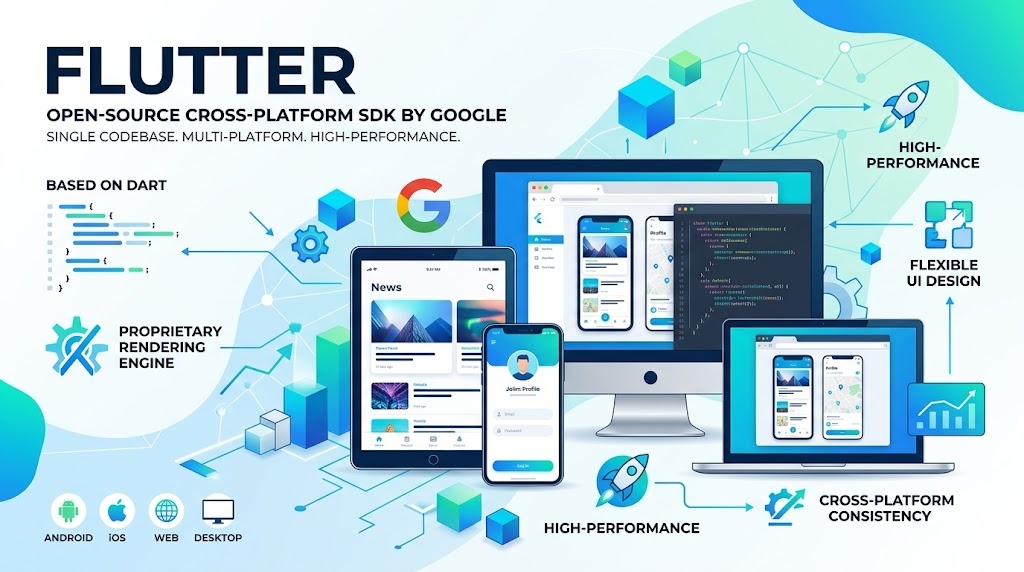
Flutter is an open-source cross-platform software development kit by Google that allows creating applications for Android, iOS, web, and desktop using a single codebase. Based on the Dart programming language and proprietary rendering engine, Flutter provides high-performance, flexible UI design, and cross-platform consistency. Flutter is highly popular for scalable mobile applications, minimum viable product startups, and visually appealing digital projects.
Useful for:
- Startup MVPs
- Ecommerce apps
- Enterprise apps
- Cross-platform apps
Pros:
- Hot reload speeds up development and testing workflows.
- Smooth UI rendering improves app responsiveness and design.
- A single codebase reduces development and maintenance costs.
Cons:
- App size is larger compared to some native apps.
- The dart ecosystem is smaller than JavaScript communities.
What is React Native?
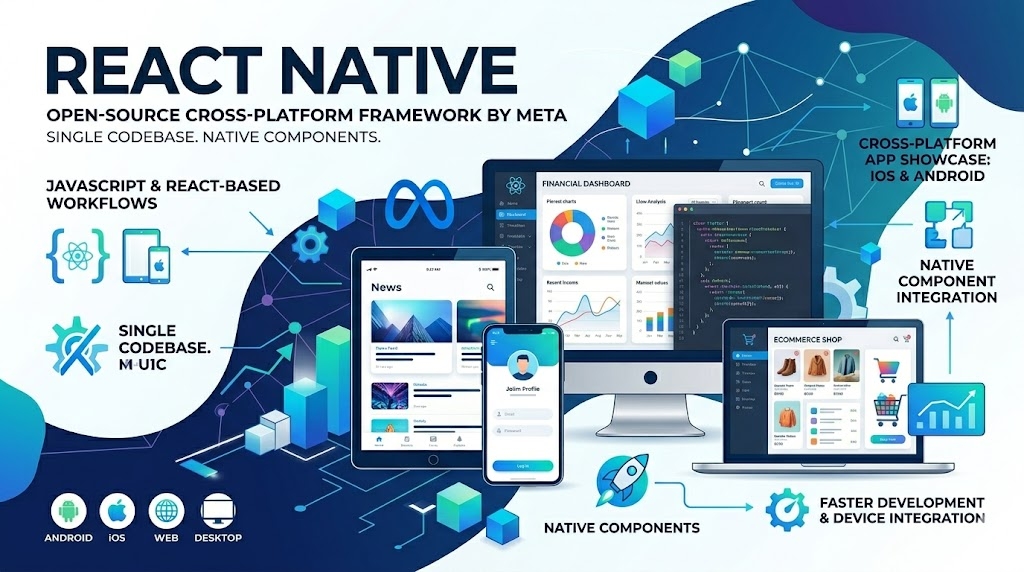
React Native is an open-source cross-platform framework developed by Meta for building Android and iOS apps using JavaScript and React. It enables developers to create mobile applications with a single codebase while using native platform components for faster development and better device integration. React Native is popular for scalable mobile apps, startup MVPs, and JavaScript-based development workflows.
Useful for:
- Startup MVPs
- Mobile app development
- Cross-platform apps
- JavaScript projects
Pros:
- JavaScript support simplifies developer onboarding processes.
- Reusable components accelerate mobile app development speed.
- Large ecosystems support plugins and third-party integrations.
Cons:
- Complex apps may require more native code integration.
- UI consistency may vary across Android and iOS devices.
Core Architecture: How Flutter vs React Native Render Your App
Understanding how Flutter vs React Native render your app reveals how code transforms into physical pixels.
React Native:
React Native manages platform-specific device components through a state-of-the-art, synchronous C++ engine. React Native does not have the luxury of drawing up a custom UI; rather, the New Architecture within this platform directly communicates with the underlying OS regarding layouts.
- JSI Direct Memory Reference: The JavaScript Interface replaces the old JSON bridge with a C++ API, enabling synchronous function calls and slashing cross-thread communication latency by up to 50%.
- Fabric UI Rendering System: Operating on a unified C++ core, this concurrent, multi-threaded engine delivers full React capabilities on mobile, prioritizing user gestures over background tasks.
- On-Demand TurboModules: Native system modules such as biometrics or Bluetooth are lazily loaded only when called, preventing unnecessary resource allocation at application startup.
- True Native OEM Widgets: Because Fabric sends layout commands directly to host components, the application automatically inherits system behaviors, like platform-authentic scrolling physics.
Flutter:
The Flutter engine does not use any native platform widget sets for rendering; instead, it creates its own set of pixels. The Google universe treats the phone screen as a complete digital canvas and uses advanced compilers to create pixel-perfect designs across all generations of phones.
- Impeller Graphics Engine: This next-generation rendering engine has completely replaced Skia on mobile, precompiling graphics shaders at build time to eliminate runtime animation junk fundamentally.
- Dart Ahead-of-Time Compilation: Your application's underlying code compiles directly into native machine architecture prior to runtime, removing any need for a translation engine during heavy user input..
- Bespoke UI Widget Engine: Flutter controls every UI element with pixel-level precision, enabling consistent interfaces and smoother workflows with advanced visual editor capabilities.
- Self-Contained Engine Packaging: The entire high-fidelity rendering pipeline is bundled, ensuring absolute layout predictability at the cost of a slightly larger initial app download size.
Flutter vs React Native Performance: The 2026 Engine Benchmarks
Analysis of actual speed, memory efficiency, and power consumption shows how new runtime updates affect application performance on both platforms.
Modern engine benchmark comparison
| Performance Metric | React Native (Fabric & JSI) | Flutter (Impeller Engine) | Benchmark Winner |
| Cold Startup Time | ~350ms average time | ~250ms average time | Flutter |
| Frame Rate (Simple UI) | 60 FPS (Stable baseline) | 60–120 FPS (Display matched) | Tie |
| Frame Rate (Complex Animations) | 55–60 FPS (Occasional drops) | 60–120 FPS (Stable under load) | Flutter |
| Memory Delta (iOS) | ~45.13 MB background footprint | ~25.33 MB background footprint | Flutter |
| Memory Delta (Android) | ~32.98 MB background footprint | ~14.00 MB background footprint | Flutter |
| Initial Download Package Size | Lighter (Uses device resources) | Heavier (Bundles layout engine) | React Native |
| Battery Drain Rate | Higher runtime thread overhead | Lower GPU-optimized consumption | Flutter |
These metrics show that Flutter's compiled architecture retains a slight edge in raw computational speed and memory conservation. However, React Native's modern synchronous architecture successfully minimizes the performance bottlenecks that previously plagued its runtime environment.
Ultimately, both frameworks now deliver highly responsive, production-ready performance that satisfies standard enterprise application requirements.
Flutter or React Native: Which Framework Is Better for Startups?
Choosing Flutter or React Native depends on startup speed, scaling plans, and product goals.
- Faster MVP Development: Using React Native, it is possible for businesses to develop their MVPs very fast by leveraging JavaScript and reusable user interface components.
- Custom UI and Branding: Flutter offers startups complete design flexibility with its own rendering engine, making it easier to create visually rich, highly consistent apps across Android and iOS platforms.
- Cost-Effective Development: Both Flutter and React Native reduce development costs by allowing startups to maintain a single codebase instead of building and managing separate native mobile applications.
- Performance and Scalability: Flutter works wonderfully when the app requires lots of animations. React Native scales very efficiently for startups that have already employed React and JavaScript in their workflows.
- Hiring and Developer Access: React Native benefits from a massive global JavaScript developer community, helping startups hire talent faster and reduce onboarding time for growing engineering teams.
React Native vs Flutter: Developer Experience and Scalability
React Native and Flutter both simplify cross-platform development, each with its own strengths.
- Developer Learning Curve: React Native is more favorable for JavaScript developers, while Flutter needs Dart but is more consistent during the entire development process.
- Development Speed and Productivity: React Native helps teams accelerate MVP development with reusable libraries, whereas Flutter speeds up UI creation through its widget-based architecture.
- Performance and Scalability: Flutter provides better performance for graphic-intensive applications, and React Native has great scalability for apps that integrate into a React ecosystem.
- Hot Reload and Debugging: Though both frameworks offer hot reloading, Flutter is superior due to consistent rendering and debugging across Android and iOS.
- Third-Party Ecosystem and Integrations: React Native benefits from a larger JavaScript ecosystem and extensive plugin availability, making integrations easier for rapidly growing products.
Choosing Between React Native and Flutter in 2026
Both React Native and Flutter are powerful cross-platform frameworks, but the right choice depends on your product goals, team expertise, and app complexity.
Choose Flutter when:
- You need highly customized UI and smooth animations across platforms.
- Your app relies on graphics-heavy experiences or consistent design rendering.
- You want near-native performance with minimal platform-specific adjustments.
- Your product requires a unified user experience on Android and iOS devices.
- You are building fintech, gaming, e-commerce, or visually interactive applications.
Choose React Native when:
- Your team already works with React or JavaScript technologies.
- You want faster MVP development and quicker developer onboarding.
- Your app depends heavily on third-party integrations and community libraries.
- You plan to share logic between web and mobile applications.
- You need flexibility for rapid updates and iterative product releases.
In 2026, Flutter is often preferred for performance-focused and design-centric apps, while React Native remains a strong choice for startups and businesses prioritizing speed, ecosystem maturity, and JavaScript scalability. Platforms like Enter Pro further simplify deployment, backend setup, and scaling workflows for both frameworks, helping teams launch production-ready apps faster.
How Enter Pro Accelerates Flutter and React Native App Development
Enter Pro makes creating apps with the Flutter and React Native frameworks much easier, enabling faster website deployment, scalability, and CI/CD. With more businesses choosing to use frameworks such as Flutter and React Native in 2026, there is a growing demand for efficient app development tools, backend integration, cloud scaling, and production management. Enter Pro simplifies these workflows and accelerates Flutter vs. React Native app deployment.
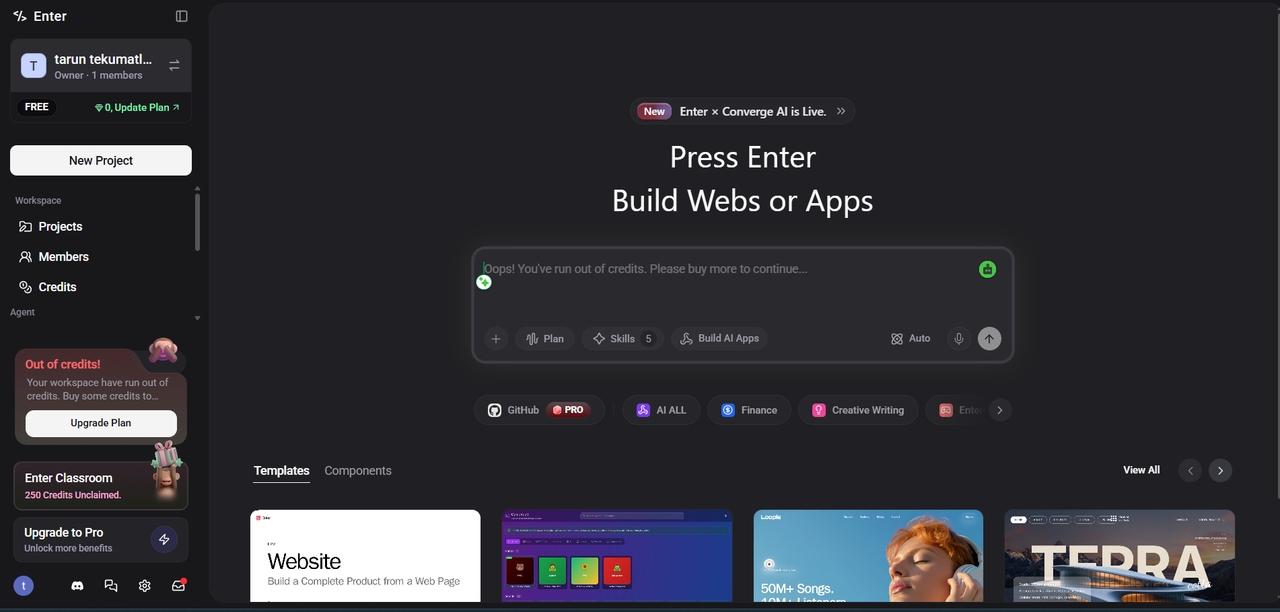
Key Features
- Faster Project Setup: Enter Pro provides pre-configured environments that help developers start Flutter and React Native projects with minimal setup time.
- Automated CI/CD Workflows: Built-in deployment automation reduces manual release tasks and improves app delivery speed across development pipelines.
- Scalable Cloud Infrastructure: Enter Pro supports scalable backend environments designed to handle growing traffic and mobile application workloads efficiently.
- Simplified Backend Integration: It is easy to integrate APIs, databases, authentication, and cloud platforms without the hassle of managing the infrastructure.
- Optimized Team Productivity: With streamlined workflows, teams working on Flutter and React Native applications can concentrate on developing the product.
- Time-to-Market Acceleration: With Enter Pro, organizations can deploy and scale their products more quickly.
Conclusion
Deciding on either Flutter or React Native depends on factors such as your application goals, team skills, performance considerations, and scalability requirements. While Flutter is better suited for apps that have high visual appeal and performance, React Native excels in apps that require quick deployment and are based on JavaScript programming. As React Native vs. Flutter debate continues in the year 2026, both frameworks continue to be great picks for creating modern cross-platform applications. To expedite the development process of Flutter and React Native apps, Enter Pro can help.
FAQ's
Which framework is easier to learn: Flutter or React Native?
React Native is easy to learn for programmers conversant with JavaScript and React, while the Flutter framework is harder because of its use of Dart, but it provides an organized environment for application development.
Does Flutter perform better than React Native for complex apps?
Flutter usually has more efficient performance when building apps that involve a lot of graphic animations, since the framework uses its own rendering engine.
Which framework is more scalable: React Native vs Flutter?
Both are scalable in their own ways; however, Flutter works well with high-performance apps, while React Native scales well for businesses using React and JavaScript.
Is Flutter or React Native better for enterprise app development?
Flutter is great when customizing enterprise-level applications needing consistent UI, while React Native is ideal for quick development of apps by large teams.
Can Enter Pro support Flutter and React Native app deployment?
Yes, Enter Pro supports Flutter and React Native deployment with scalable infrastructure, automated CI/CD workflows, backend integration, and simplified production management for faster app releases.