How Synova used Enter to Create an AI App for Parkinson's Speech & Gait Freezing
Synova helps people with Parkinson's communicate clearly and walk safely using AI-powered speech transcription and real-time gait rhythm cues. Discover how it works.
Most accessibility projects start with a user research report. A demographic identified, a condition defined, a problem scoped. Something gets built for a category of people the team has studied but never sat across from.
Synova started somewhere different.
Prishaa's uncle has Parkinson's. Eesha's grandmother has Parkinson's. When these two sat down at HackPrinceton Spring 2026 to decide what to build, they were not thinking about a demographic. They were thinking about specific people. Real moments. The moment when someone knows exactly what they want to say, knows exactly what they want to do, and the technology around them fails anyway.
That is a different starting point. And it produced a different kind of project.
What Parkinson's Actually Does to Daily Life
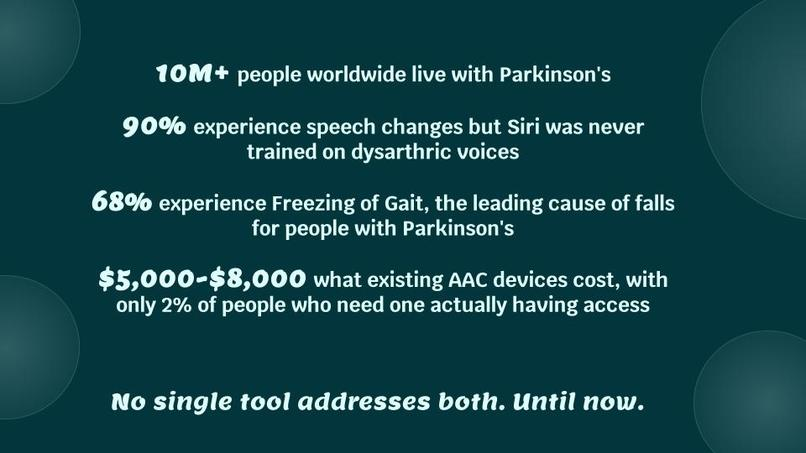
Parkinson's disease is often described in terms of its most visible symptom: the tremor. But the reality of living with Parkinson's is wider than that, and it shows up in two areas that Synova's team kept coming back to.
The first is speech. Parkinson's affects the muscles involved in talking — the result is called dysarthric speech, and it sounds different enough from typical speech that the transcription tools most people rely on struggle to process it accurately. A system can technically return text and still be completely useless. The words come back wrong, or broken, or repeated. The person trying to communicate something simple and urgent is no closer to being understood.
The second is movement. Freezing of gait — a sudden, involuntary pause in walking where the feet feel locked in place — is one of the most disorienting and dangerous symptoms of Parkinson's. It happens without warning. And it happens to people who are otherwise completely aware of their surroundings, who want to move, who simply cannot.
Synova addresses both.
Two Features, One Through-Line
Speak is the communication side. It records speech, runs it through a transcription pipeline, and then does the work that standard systems skip: it normalizes the output into something actually usable. Not just technically correct text — communicatively useful text. A phrase that reflects what the person was trying to say, not just what the algorithm heard.
The team also built a voice bank into Speak — a way to save common phrases and replay them quickly. For someone with Parkinson's, having pre-saved versions of the things they say most often is not a convenience feature. It is a way of preserving a part of their voice even as the condition progresses.
Walk is the movement side. It uses motion data from a smartphone, processes it in real time, and generates audio cues — beats, sounds — that give the user a rhythm to walk to. The system detects when gait is becoming irregular and when freezing is likely, and adapts the feedback accordingly. The audio is spatially positioned to feel like it is coming from in front of the user — a subtle but deliberate design choice. The sound becomes something to walk toward, not just something to listen to.
The two features are connected by the same insight: the problem is not the technology. The problem is whether the technology is actually useful for the person using it.
The Distinction That Shaped Everything
The team's most important learning from building Synova is also its clearest articulation of the problem they set out to solve.
"A system can technically work and still fail the user. Usefulness mattered more than whether the raw output looked close enough."
That sentence deserves to be read carefully, because it is a critique of how most assistive technology gets evaluated. Systems get measured on technical benchmarks. Word error rates. Response times. Processing accuracy. And those benchmarks matter — but they are not the same thing as whether the person who needed help actually received it.
The team built a compare flow into Speak specifically to make this visible. Users can see, side by side, what standard transcription returns versus what Synova returns. The difference is often dramatic. Standard output that is technically a transcription of what was said — broken words, repeated sounds, phonetic debris — versus a phrase that is actually understandable and usable. The gap between working and helping is right there on screen.
That gap is what Synova exists to close.
Why We Were There
Enter was at HackPrinceton Spring 2026 — 410 participants, 36 hours on Princeton's campus — because we believe that the best ideas should not be stopped by technical barriers. We go to events like this to be close to the people who are building things that matter, and to support the next generation of builders who are doing work the world needs.
The ideas we care most about are not always the ones with the most technically impressive architecture. Sometimes they are the ones that come from the most personal place. The ones where the team does not need to explain why the problem matters, because the problem is already sitting in the room with them.
Synova is one of those. Two builders, two family members with Parkinson's, one weekend to build something real. The ambition was not to win a prize. It was to build something that would actually help people they love.
What Comes Next
The team wants Synova to become a full end-to-end communication system. Stronger transcription, more reliable phrase recovery, a voice bank that becomes more personalized over time as it learns the phrases a specific user reaches for most. On the Walk side, more real movement data and better feedback tuning — because the system only improves by encountering the full variability of how different people move.
The longer vision is a tool that grows with the person using it. One that does not just respond to Parkinson's but adapts to how Parkinson's changes for a specific individual over time.
That is not a small ambition. But it started with a specific uncle and a specific grandmother, and that is exactly the right place to start.
The team behind this built : prishaakapasi| Eesha Sutaria| gk7494
Missed the earlier volumes? → Vol. 1 — Heritage in Pixels → Vol. 2 — Terra Zone AI → Vol. 3 — reAgent → Vol. 4 — TaleTailor → Vol. 5 — LEGR → Vol. 6 — PolyPath → Vol. 7 — EcoThread→ Vol. 8 — Aletheia