How TaleTailor built a live AI storytelling app in 36 hours with Enter
Discover TaleTailor, an AI-powered interactive storytelling app from HackPrinceton 2026. Choose your path, shape the narrative, and experience branching stories like never before.
"A reader lives a thousand lives before he dies. The man who never reads lives only one." — George R.R. Martin
There is something that happens when you read a great story. You disappear into it. You stop being yourself for a while and start being someone else. Someone with a problem to solve, a world to navigate, a choice that matters.
Most of us grew up with that feeling. Then life got busy. Screens got shorter. Attention spans got stretched in twelve directions. And somewhere along the way, the stories got left behind.
The team behind TaleTailor noticed that gap; between reading a story and actually living one. And at HackPrinceton Spring 2026, they did something about it.
Welcome Back to our User Story Serie of the HackPrinceton 2026 where we dived in porjects that caught our attention !
What TaleTailor Actually Is
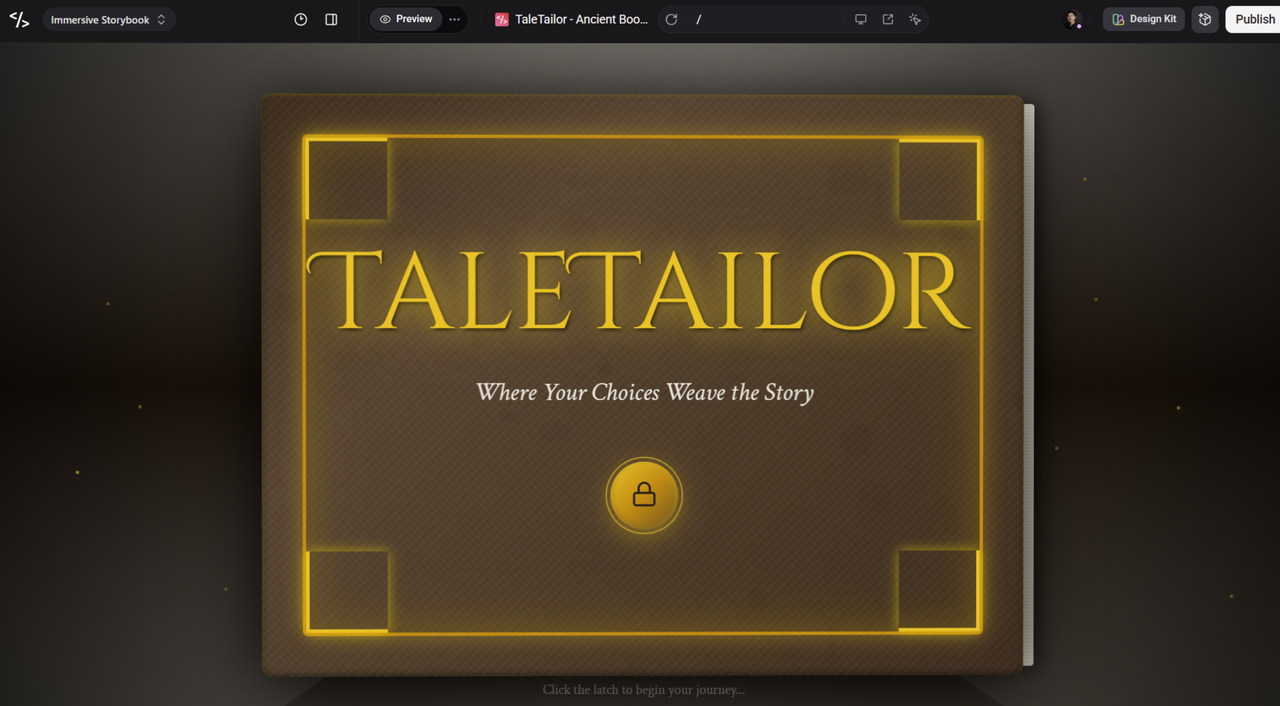
TaleTailor is an interactive storytelling web application.
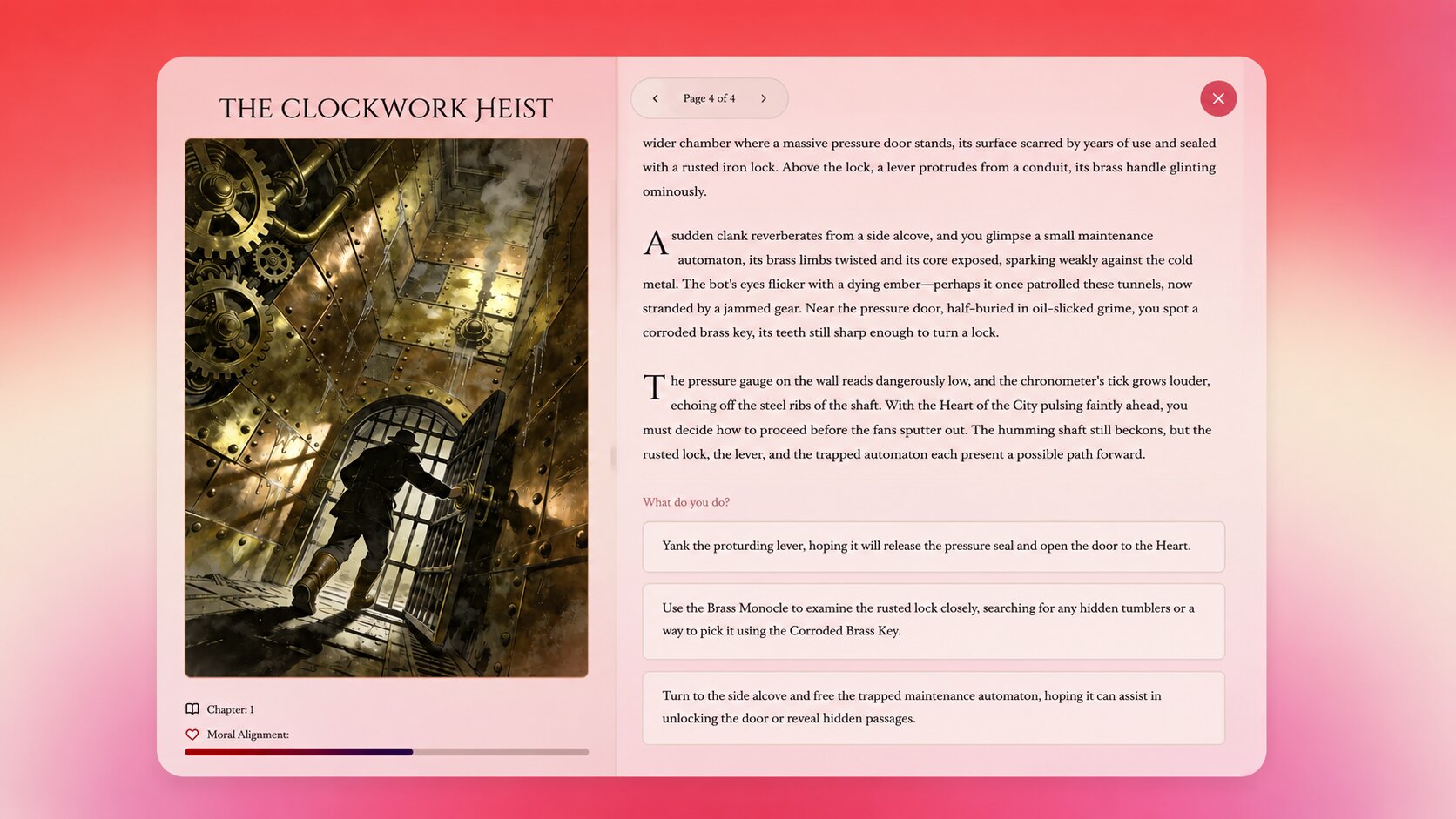
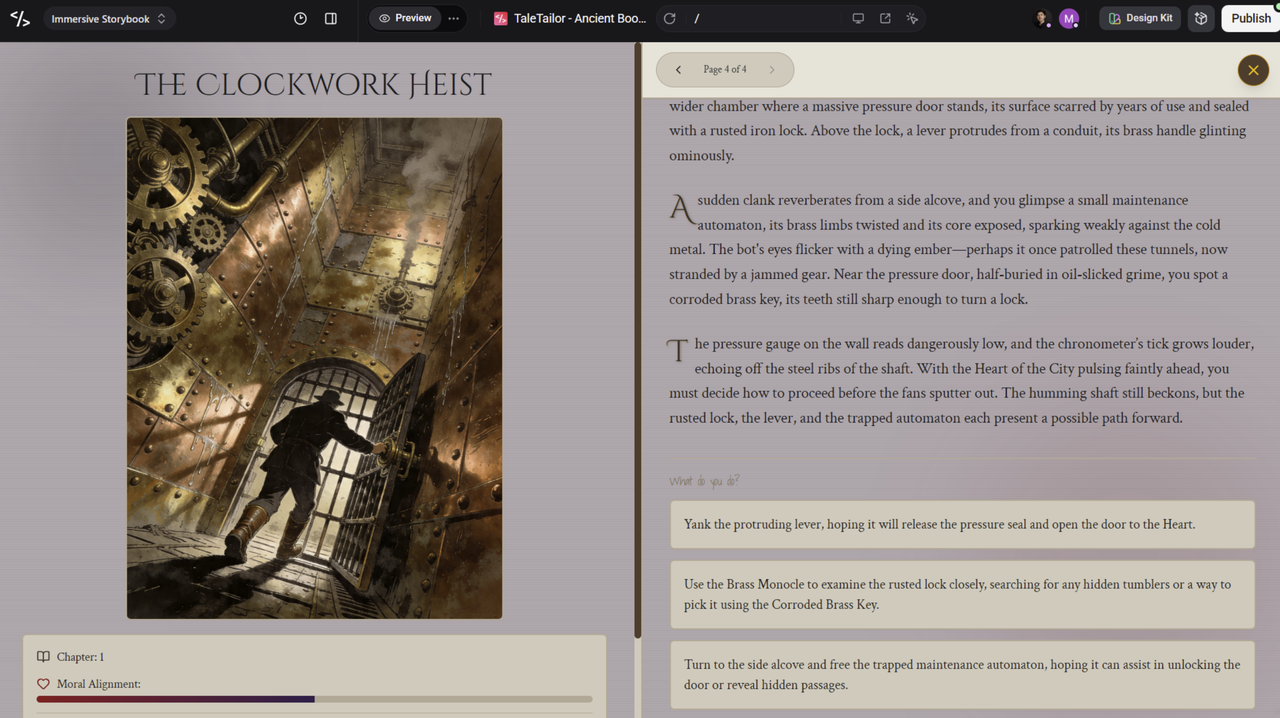
Think of the Choose Your Own Adventure books; the ones where you flipped to page 47 if you opened the door, or page 112 if you ran. Now imagine that instead of a fixed set of pages, the story reshapes itself around every choice you make. The illustrations change as the scene changes. Your inventory updates in real time: a copper key here, a steam lantern there, a mysterious book you are not sure what to do with yet. And no two players reach the same ending.
That is what TaleTailor built. Four worlds to step into: The Clockwork Heist, The Last Sentinel of Aethelgard, Whispers of the Trench, and The Alchemist's Debt. Each one a fully branching narrative, powered by AI, illustrated as you go.
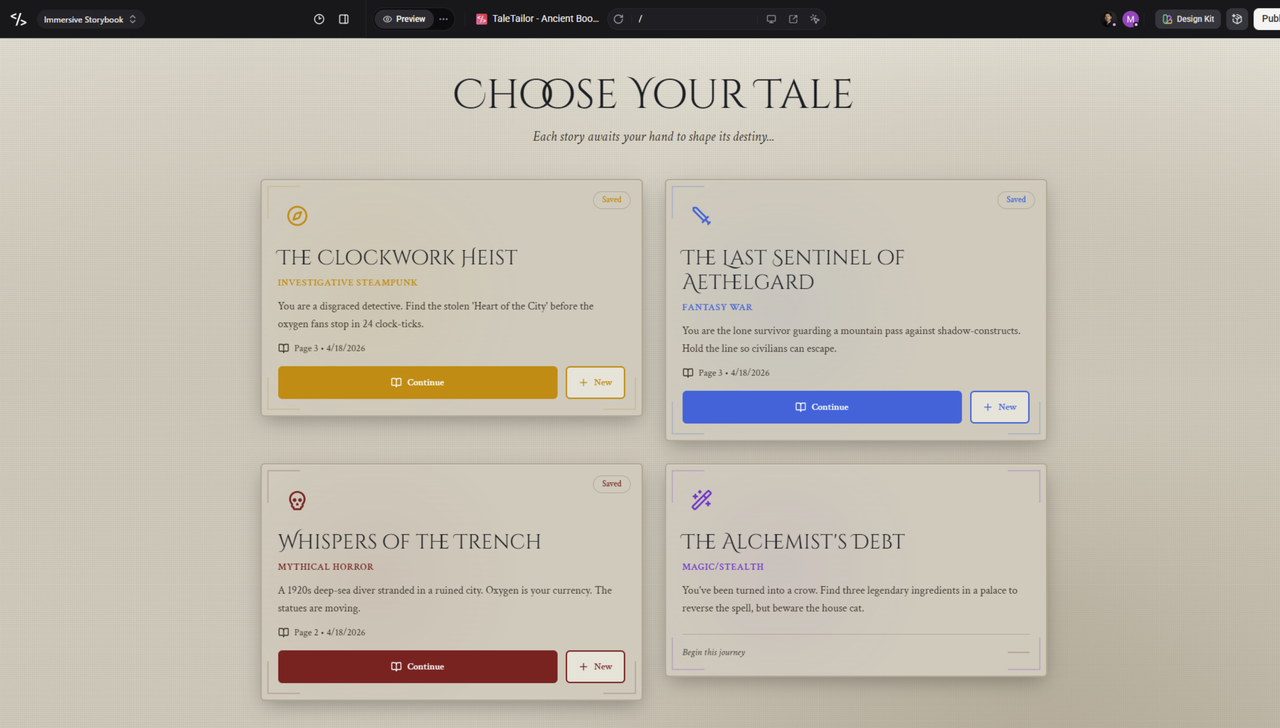
The platform puts you in the main character's seat and asks you, at every turn: what do you do?
Your answer determines everything.
The Idea Behind the Build
The inspiration was honest and simple. Modern life is full, fast, and loud. Entertainment has mostly followed that same energy: shorter, faster, more fragmented. What TaleTailor's team wanted to build was the opposite: something immersive, something that required your attention because it was worth your attention. A middleman, as they put it, between reading a story and living one.
The reference point was classic: Choose Your Own Adventure books, the kind you read as a kid and immediately flipped back to try the other ending. The ambition was modern: what if that experience was dynamic, AI-generated, and unique to every single player?
That was the starting point. What happened next was a hackathon.
The Crisis They ran into
Here is the part of the story that does not make it into the demo deck.
When the TaleTailor team sat down at HackPrinceton to start building, they ran straight into a wall. The university's eduroam Wi-Fi blocked Enter.pro's domain entirely. No workaround. No quick fix. The primary development environment — unavailable.
A lesser team might have pivoted. Found a different tool. Simplified the project to fit the constraints.
But they refused to switch.
They packed up their gear and walked to the Princeton Public Library. Free Wi-Fi, working connection, back in business. When the library closed for the night, they relocated to a local café and kept going. Miles walked back and forth between the hackathon venue and wherever they could find a signal, because there were workshops they wanted to attend, and code they still needed to ship.
That refusal to quit is worth naming. Because it is the thing that separates a project from a product. Anyone can build when the conditions are perfect. These builders had no perfect conditions. They had a deadline and a decision not to stop.
How They Built It
Before writing a single line of code, the team mapped the logic. They thought through how a branching story actually works, what information needs to travel between a player's choice and the next scene, how inventory should update, what the game needs to remember and when. Architecture first. Code second.
That thinking shaped everything. Every choice a player makes triggers a chain: a narrative update, an illustration that reflects where the plot is headed, an inventory that shifts based on what the character now carries. The game reads those updates and renders them in real time. And when a player closes the tab and comes back the next day, their session is exactly where they left it: every decision preserved, every item accounted for. Continue the story or start a new one. The game remembers either way.
There was one major technical obstacle mid-build. An integration was breaking in ways that were hard to trace: outputs coming back in an unexpected format, the code unable to parse them correctly. The fix required going back to first principles: understanding exactly what the system was returning, why it differed from what they expected, and how to adapt their implementation accordingly. They used Enter.pro to surface the error, identify the origin, and rewrite around it. The platform that was building the game also helped them fix it. That kind of closed loop is not something you plan. It happens when you have built your environment well enough to trust it.
What They Are Proudest Of
Ask the team what they are most proud of, and they do not lead with the technology. They lead with the game loop.
The seamless combination of complex reasoning with an interactive UI that handles unpredictable player inputs, gracefully, every time; that is what they mention first. Not as a technical achievement, though it is one. As a feeling. They made something unique, something that works, something a player can actually get lost in.
All of it in 36 hours. While hiking between a library and a café.
What Comes Next
TaleTailor is not finished. The team sees it growing in two directions: entertainment and education.
On the entertainment side, a Custom Imagination Engine : where players input a single sentence and the AI generates an entire playable universe around it. On the education side, an Interactive Dictionary built directly into the narrative: players highlight unfamiliar words and see definitions in context, turning a story session into a vocabulary session without it feeling like one. And Cinematic Audio: sound effects that shift with each scene, because a heist in a clockwork city should sound different from a trench at the edge of the world.
The foundation is already there, and possibilities of development are endless.
Why This One Stays With Us
We write about projects built on Enter because we believe that the best ideas should not be stopped by technical barriers. TaleTailor is a reminder that those barriers are sometimes literal: a Wi-Fi block, a library closing at nine, an API that will not cooperate.
What makes a builder is not the absence of those obstacles. It is the decision to walk the miles anyway.
The blank screen never stood a chance.
→ Try TaleTailor live: e44288b18b694ca1a2f74e8ac2260c69.prod.enterapp.pro
Missed the earlier volumes? → Vol. 1 — Heritage in Pixels → Vol. 2 — Terra Zone AI → Vol. 3: reAgent