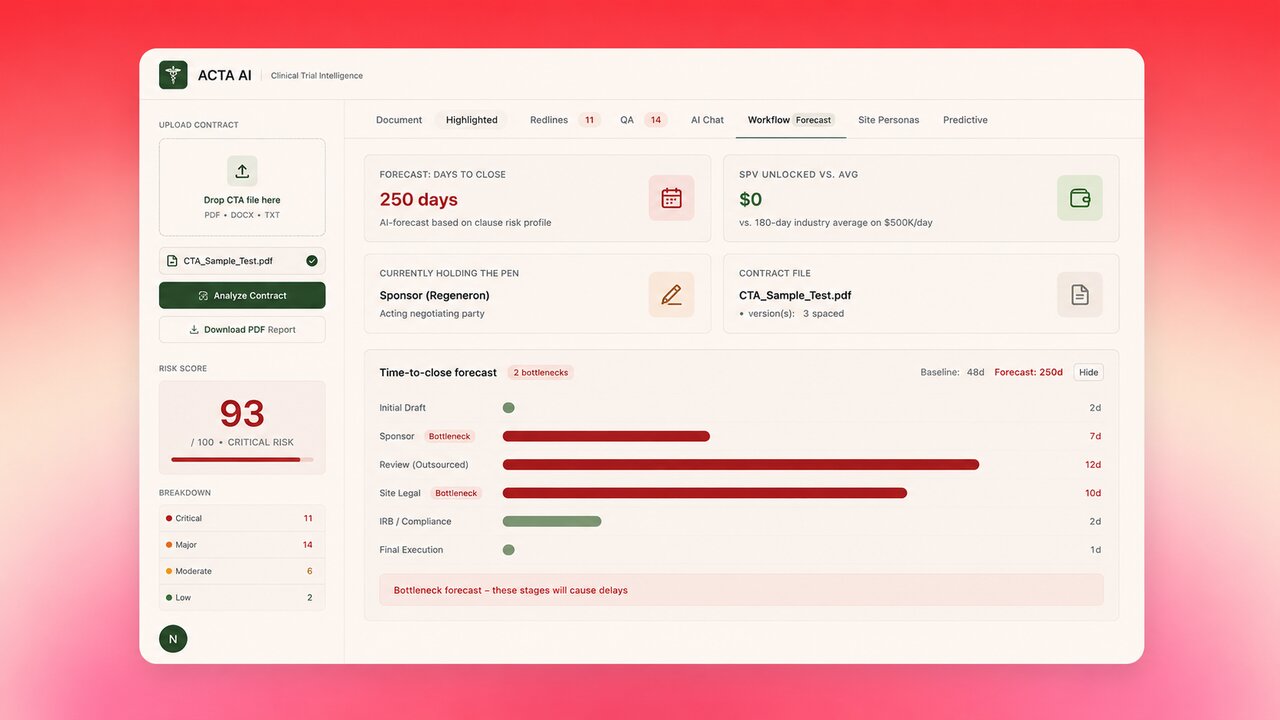
The Paperwork Problem That Costs Patients Two Months - Using Enter to Solve it
ACTA AI uses multi-agent contract intelligence to cut clinical trial agreement negotiations by 50 days, unlocking billions in pipeline value and faster patient access.
Enter was at HackPrinceton Spring 2026 — 410 participants, 36 hours, on Princeton's campus. The team behind ACTA AI chose the hardest problem in the room. And they knew exactly why.
A Humanitarian Problem Wearing a Legal Disguise
Every day a clinical trial is delayed, patients with aggressive cancers, rare diseases, and chronic conditions wait longer for therapies that could change or save their lives.
Before a single patient can enroll in a trial, pharmaceutical sponsors and clinical research sites must negotiate a Clinical Trial Agreement — a complex legal document covering intellectual property, indemnification, publication rights, patient privacy, and regulatory reporting obligations. This negotiation takes an average of 100 days. At $800,000 to $1.4 million in lost pipeline value per day, the financial cost is significant. But the more important number is the one that does not appear in any financial model: the patients on the other side of that delay who are out of time.
For a company running 56 active clinical-stage programs, shaving 50 days off each negotiation unlocks over $2.24 billion in pipeline value. More importantly, it means patients facing aggressive lymphomas or rare inflammatory diseases get access to potentially life-saving therapies nearly two months sooner.
The team did not frame this as a legal automation problem. They framed it correctly: as a humanitarian problem that happens to look like paperwork.
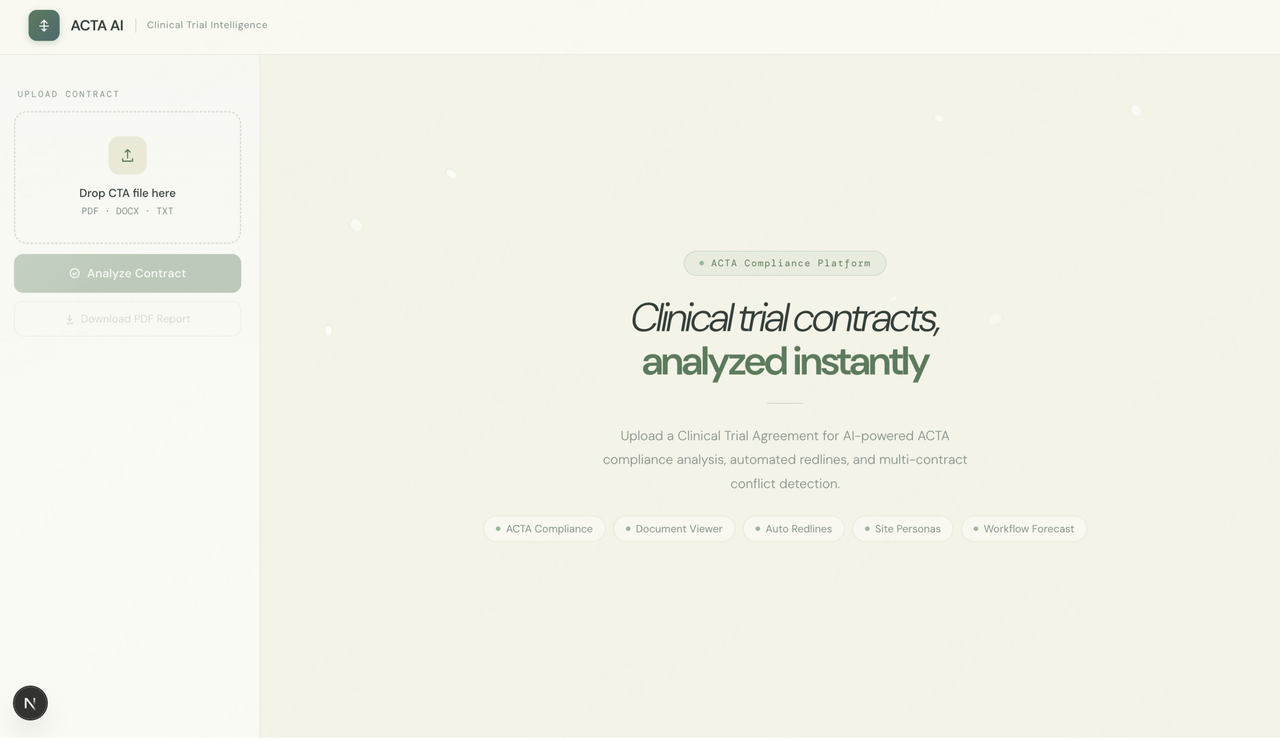
What ACTA AI Actually Does
ACTA AI is a multi-agent contract intelligence platform built around the clinical trial agreement process — designed to do what no commercial legal AI tool currently does: analyse contracts clause by clause, enforce a standardised baseline, track negotiations across versions and parties, and surface cross-contract conflicts before they become legal crises.
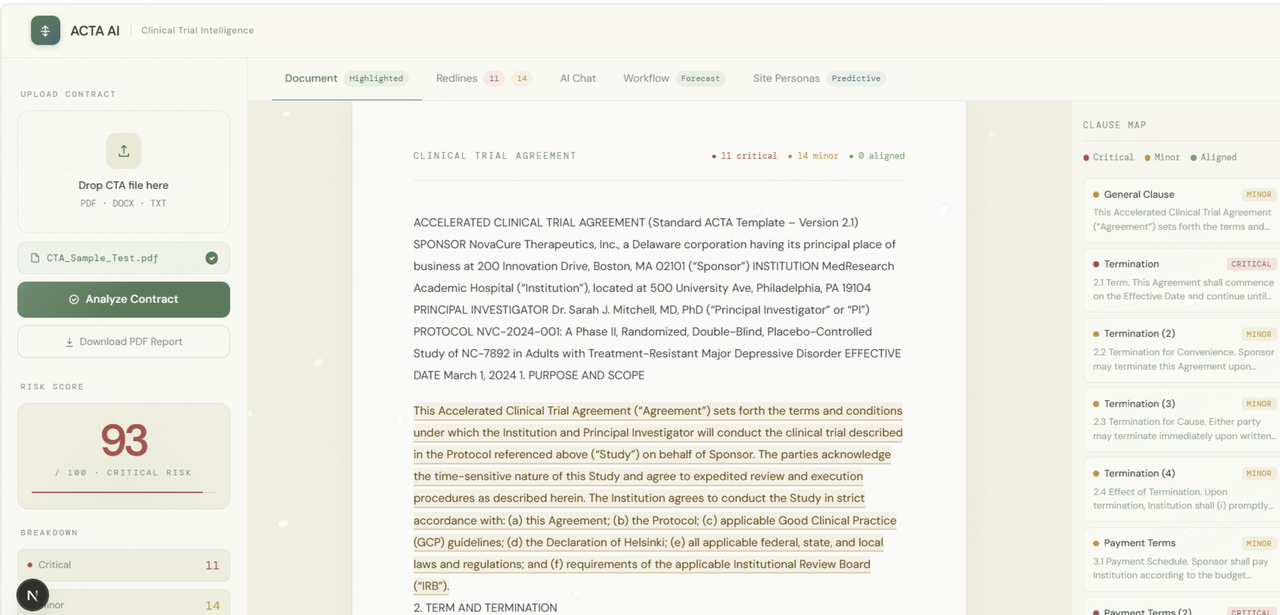
The architectural decision that defines the whole product is also the simplest to explain. A 30-page legal contract thrown at a language model as a single block of text produces unreliable output. The team went the other direction entirely. Every contract is split into individual clauses, each one analysed independently against a hardcoded baseline of seven ACTA standards — publication review windows, indemnification structure, payment terms, confidentiality duration, indirect cost caps — before results are aggregated into an executive summary. The structure is what separates a legal intelligence tool from a sophisticated search box.
ACTA AI's clause analysis interface, showing independent compliance scoring for each contract section against the ACTA baseline — deviations flagged by severity before the executive summary is generated.
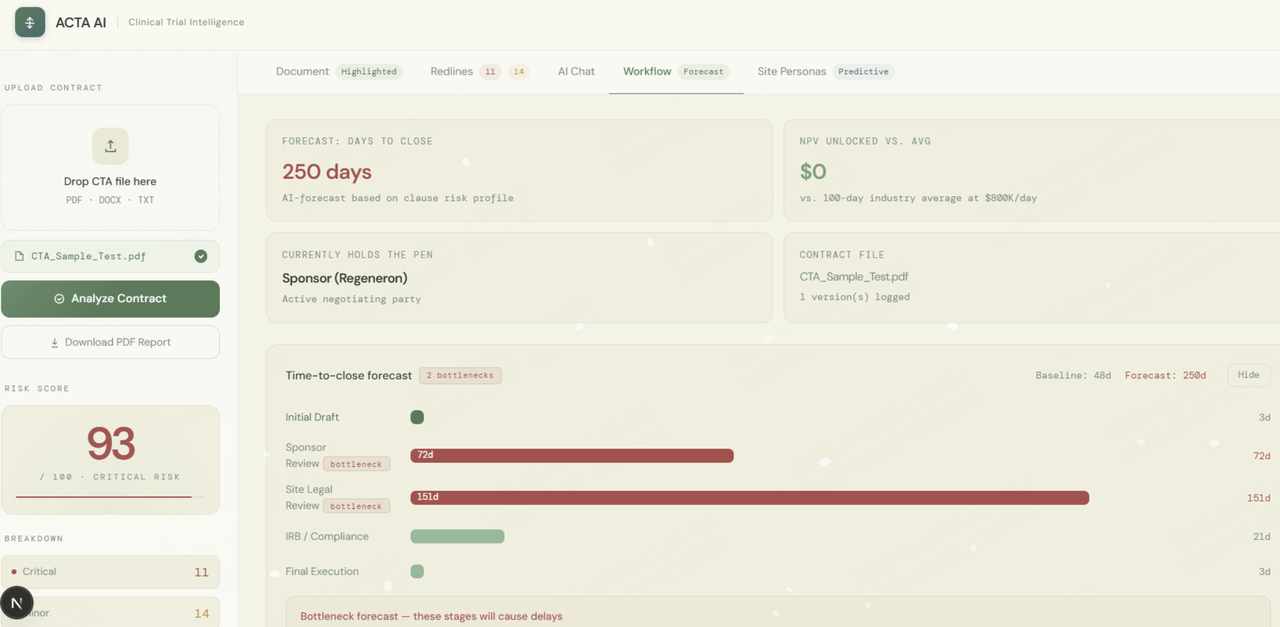
A confidence scoring system triage every clause into four categories: aligned with the baseline and ready to proceed, a minor deviation with a standard fix, a critical deviation that will cause multi-week delays if unresolved, or language the system has not encountered before and routes directly to a human lawyer. A two-person legal team can manage 50 simultaneous contracts because they always know where to look first.
One-click ACTA Mode addresses the scenario where a negotiation has completely stalled. A single button rewrites every deviating clause to the baseline simultaneously, generating a side-by-side track-changes view and a ready-to-send negotiation memo explaining every change to the other party.
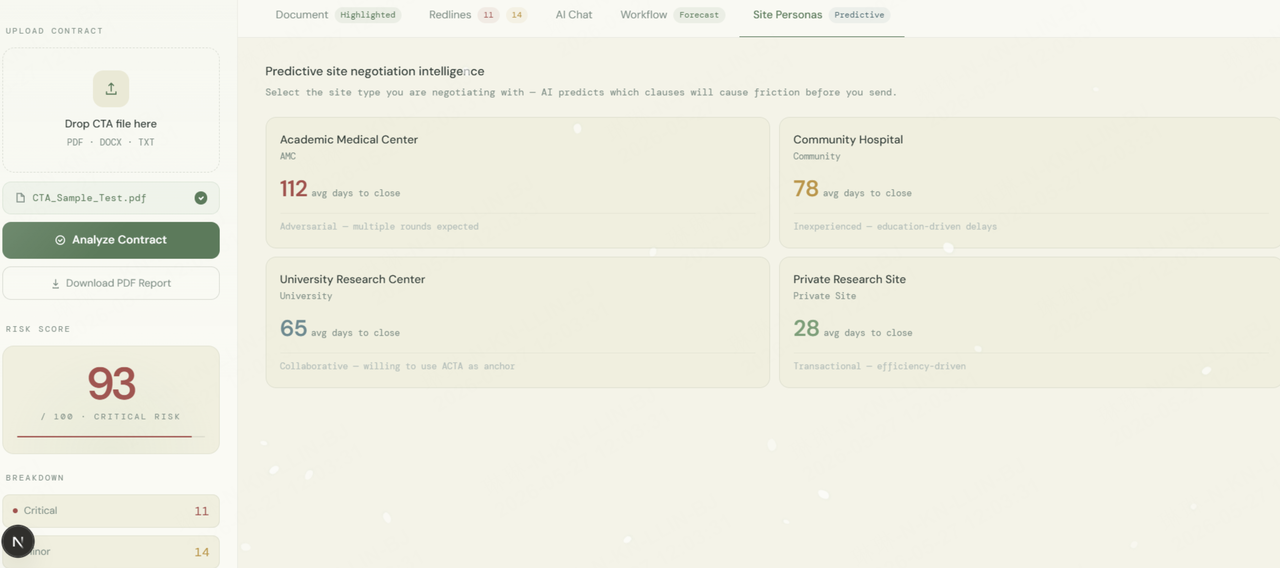
Predictive Site Personas account for something that generic contract tools ignore entirely: different hospitals negotiate differently. An academic medical centre and a regional community hospital have different legal priorities, different reflexes, and different red lines. ACTA AI predicts where friction will emerge before the contract is even sent.
The Multi-Party Conflict Detector — which the team described as the feature that surprised them most — solves a problem that currently requires senior lawyers manually cross-referencing hundreds of documents. Upload multiple CTAs, run the scan, and the system surfaces inconsistencies across contracts: conflicting IP grants to different sites for the same compound, incompatible publication windows promised to separate institutions. What previously surfaced as a legal crisis months into a programme now surfaces in seconds.
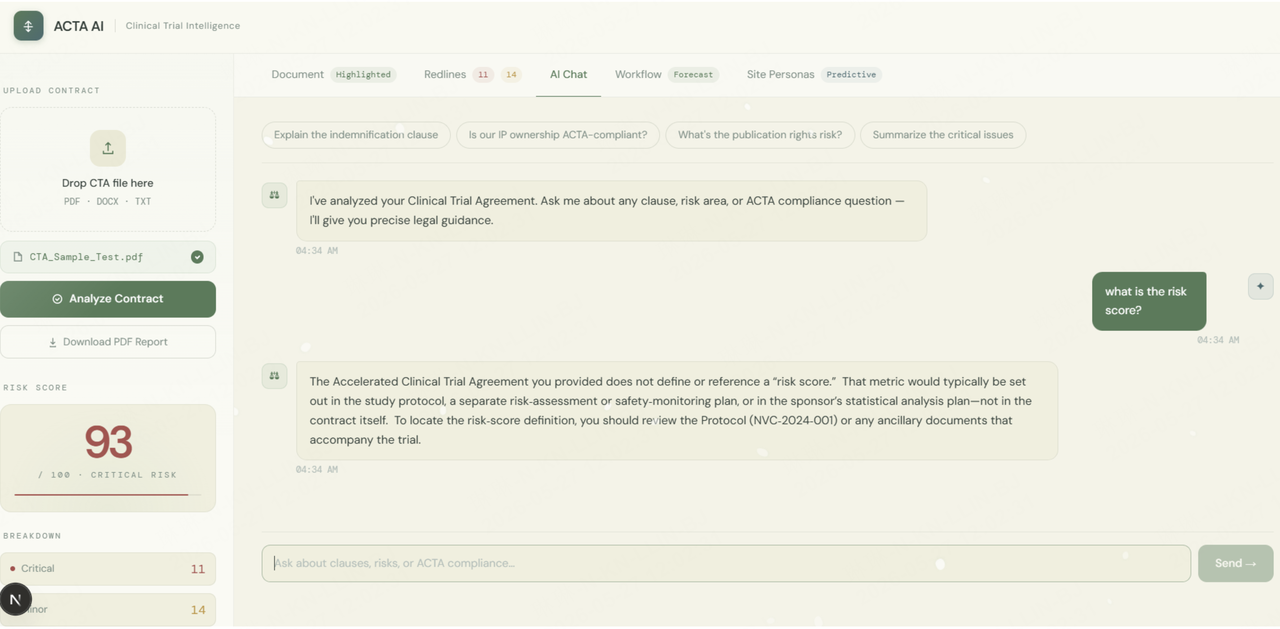
The Multi-Party Conflict Detector interface, showing cross-contract inconsistencies flagged across simultaneous Clinical Trial Agreements — a capability the team built in three hours that may be the most commercially significant feature in the product.
How It Came Together
The backend is a four-agent pipeline — Document Parser, Clause Extraction, Risk Identification, Compliance Check, Suggestion — with a shared state object carrying extracted clauses, risk findings, compliance results, and version diffs through every step. The architecture also includes a routing layer that mirrors how law firms actually allocate work: legal-heavy clauses go to a model optimised for legal reasoning, fast classification tasks go to a model optimised for speed, and complex rewrites go to a model optimised for language quality. The right model for the right job, built into the system rather than left to chance.
None of the team had built a production multi-agent pipeline before the weekend started. The architecture went through three complete redesigns before landing on the one that actually held. Looking back, the team described those early arguments as the most valuable hours of the hackathon.
The frontend was rebuilt twice — intentionally. The visual language is warm creams, sage greens, and muted teals. The reasoning behind those choices was stated plainly: clinical software should feel trustworthy and calm. The design is a product decision, not a stylistic one.
What They Are Proudest Of
That it works on real documents.
Real Clinical Trial Agreements — messy formatting, unusual clause ordering, legal language the system had never encountered in development — and the pipeline handles them. Edge cases degrade gracefully. Fallbacks engage cleanly. Structured output holds.
The Multi-Party Conflict Detector almost did not make it into the submission. It was a late addition built in three hours. They shipped it anyway, and they believe it is the most commercially valuable thing in the product.
They are also proud of something that does not appear in the demo: at hour 28, tired and under pressure, they did not take it out on each other. They described being respectful to your team under pressure as a skill, and treating it as such. That is not a small thing. It is probably why everything else got finished.
The Multi-Party Conflict Detector is the first priority — moving from a working prototype to persistent contract storage, conflict history tracking, automated alerts, and network visualisation showing which sites share overlapping legal terms.
Privacy-first architecture is next. Clinical Trial Agreements contain sensitive information about both patients and organisations. The next version needs end-to-end encryption, role-based access controls, and a data handling framework that satisfies regulatory requirements for both sides of the negotiation. Trust, as the team put it, is the foundation of any legal product. They want to earn it properly.
The longer-term ambition is agent learning from real cases — feeding actual negotiation outcomes back into the system so it refines its risk models over time. Which deviations caused delays. Which redlines got accepted. Which site types pushed back hardest on which clauses. The system gets smarter with every contract it processes.
And eventually, longitudinal negotiation intelligence: a feature that tells a legal team exactly how a given site has negotiated in the past, what language they ultimately accepted, and where friction is most likely to emerge — the kind of institutional memory that currently lives in the heads of individual lawyers, made accessible to everyone on the team.
The Problem Worth Solving
ACTA AI was not built to win a track. It was built because the problem is real, the math is brutal, and nobody has actually solved it.
The gap between a promising therapy entering trials and a patient gaining access to it is not primarily a scientific problem. It is a coordination problem, a documentation problem, a process problem — exactly the kind of problem that structured intelligence applied at the right layer can collapse.
The team saw that gap and spent 36 hours building something that pushes it closed. The patients on the other side of that negotiation table do not have 100 days to wait.
Team members: Han Wang || Xinying Cai || Saumya Brahmbhatt
Missed the earlier volumes? → Vol. 1 — Heritage in Pixels → Vol. 2 — Terra Zone AI → Vol. 3 — reAgent → Vol. 4 — TaleTailor → Vol. 5 — LEGR → Vol. 6 — PolyPath → Vol. 7 — EcoThread→ Vol. 8 — Aletheia → Vol. 9 — Synova → Vol. 10 — Overturn Insurance→Vol. 11 — VentureLink →Vol. 12—Atlas: Immersive 3D AI Learning