
What Is a Pitch Deck? Definition, Purpose and Key Slides
Discover what a pitch deck is and why it is a crucial tool for startups seeking investment. Learn the pitch deck meaning, its main purpose, key components, and how to create an effective business pitch deck that captures investor attention.
Every startup founder reaches a point where a great idea is not enough. To attract investors, partners, or funding, you need to communicate your vision quickly, clearly, and convincingly. That is where a pitch deck comes in. A pitch deck is a short, visual presentation that gives your audience a fast overview of what your business does, who it serves, and why it is worth backing. Whether you are approaching venture capitalists, angel investors, or accelerators, your pitch deck is often the first thing they will see. This guide covers the pitch deck definition, its core purpose, key slides, and how to create one that gets results.
What is a pitch deck?
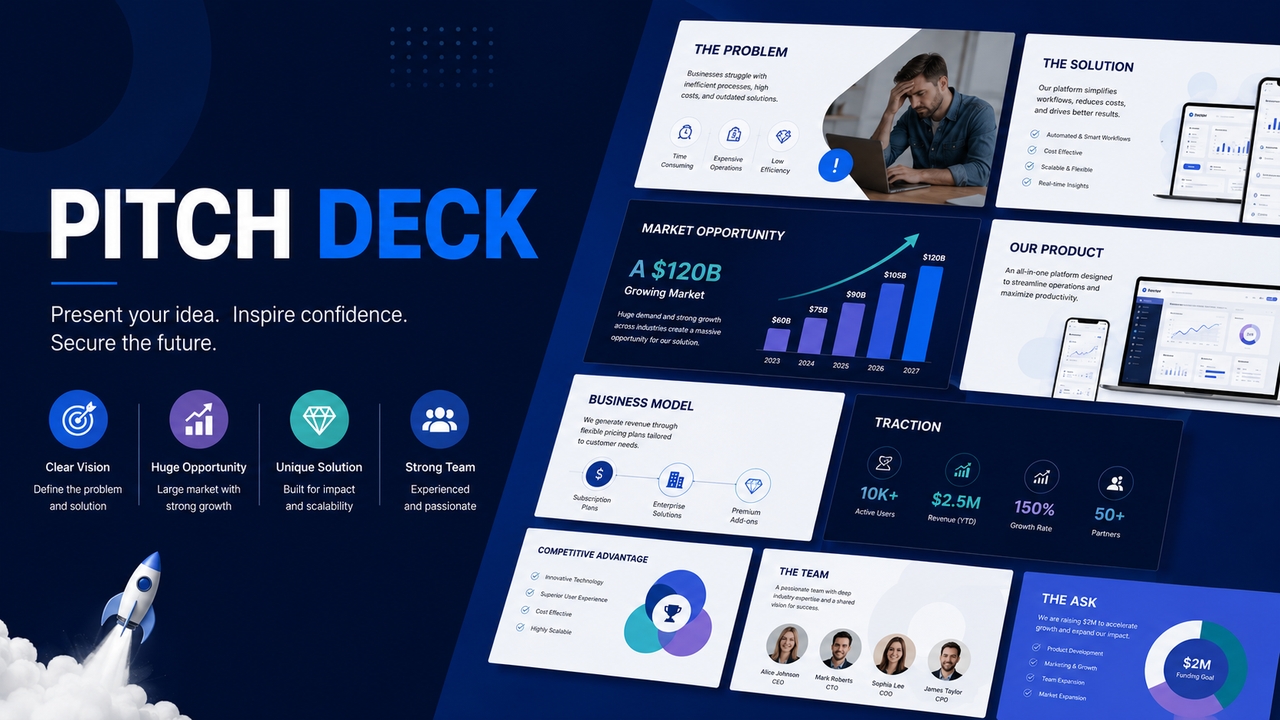
A pitch deck is a brief, visual presentation, typically 10 to 20 slides, that founders and entrepreneurs use to introduce their company to potential investors. It provides a high level snapshot of the business, covering what problem is being solved, how the product or service addresses it, the size of the market opportunity, the business model, the team behind it, and the funding being sought.
The pitch deck meaning goes beyond just slides. It is a storytelling tool that balances data, design, and narrative to convince an audience that the business is viable and worth investing in. A well built business pitch deck does not just inform, it builds confidence.
A pitch deck has effectively replaced the lengthy business plan of earlier decades. While shorter in format, it still demands the same level of research and strategic thinking to tell a compelling story.
Understanding the purpose of developing a pitch deck
A pitch deck helps businesses present ideas clearly, attract investors, explain growth potential, and build confidence through a concise and engaging presentation.
- Presenting the business idea clearly: A pitch deck helps founders explain their business concept in a simple and structured way. It gives investors a quick understanding of the company and its vision.
- Attracting potential investors: One of the main goals of a business pitch deck is to capture investor interest and encourage further discussions about funding opportunities.
- Explaining the market opportunity: A pitch deck highlights the target audience, market demand, and growth potential to show why the business has long term value.
- Showcasing the product or service: The presentation demonstrates how the company’s product or service solves a specific problem and stands out from competitors.
- Building credibility and trust: A well designed pitch deck helps establish professionalism and confidence by presenting clear data, business strategies, and realistic goals.
- Highlighting the business model: Investors want to understand how the company plans to generate revenue. A pitch deck explains the monetization strategy and future scalability.
- Introducing the team: The deck allows founders to showcase the expertise and experience of the team behind the business, which is often a key factor for investors.
- Driving funding decisions: Ultimately, the purpose of developing a pitch deck is to persuade investors that the business has strong potential and deserves financial support.
Key components of a strong pitch deck
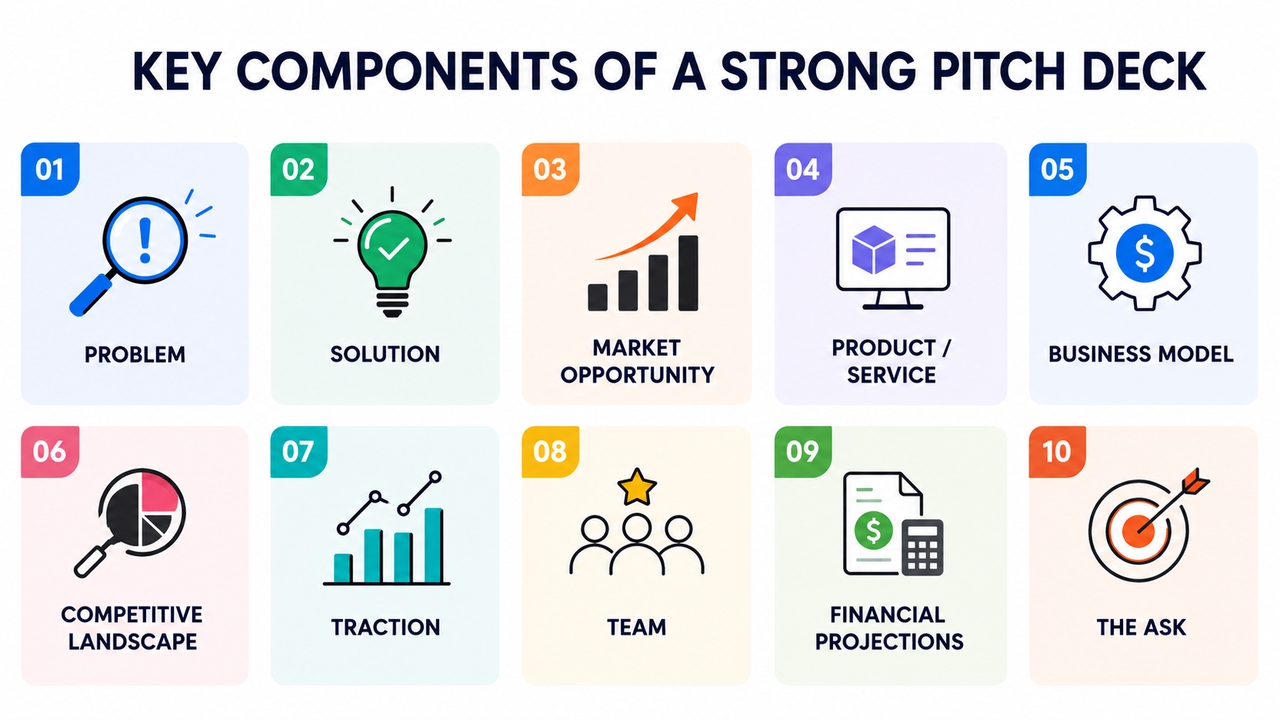
A successful pitch deck combines clear messaging, strong visuals, and relevant business information to capture investor interest and communicate growth potential effectively.
Problem slide
Start by defining the pain point your target customers face. The problem should be specific, backed by data, and urgent enough to demand a solution. Investors need to understand who has this problem, how often it occurs, and why it matters now.
Solution slide
Present your product or service as the direct answer to the problem. Focus on the core value proposition rather than listing every feature. The goal is to show a clear connection between the problem and what you have built to solve it.
Market opportunity
Investors want to know how big the prize is. Include the total addressable market, serviceable addressable market, and relevant industry trends. This slide answers the question of why your solution is worth investing in from a financial standpoint.
Product or service
Give a concise walkthrough of how your product works at a high level. Screenshots, demos, or visuals work well here. The focus should be on what makes your approach different from existing options.
Business model
Explain how you make money. Whether it is a subscription, licensing, marketplace, or direct sales model, investors need to see a clear path to revenue. Detail how you plan to get the product to market and what unit economics look like.
Traction
Data on product demand can be a major advantage, especially for early stage companies. Customer counts, revenue figures, monthly recurring revenue, retention rates, letters of intent, or even results from customer discovery interviews all demonstrate that the market wants what you are building.
Competitive landscape
Acknowledge your competitors and clearly explain what sets your business apart. A feature comparison matrix works well here. Avoid claiming you have no competition, as this tends to signal a lack of market awareness rather than a genuine gap.
Team
Investors often say they back people as much as ideas. Highlight the founding team's relevant experience, domain expertise, and connection to the problem. If there are gaps in the team, list the advisors or consultants who are helping fill them.
Financial projections
Financial projections provide estimated revenue, expenses, and profitability over a specific period. Investors use this information to evaluate growth potential, funding requirements, and expected returns while assessing whether the company’s financial strategy appears realistic and achievable.
The ask
End with a clear funding request. State how much you are raising, the terms if applicable, and how the capital will be used to hit your next major milestones. This is often the slide founders forget or downplay, but it is one of the most important parts of the presentation.
How to create an effective pitch deck
Creating an effective pitch deck requires more than attractive slides. A successful presentation combines clear storytelling, strong market understanding, and concise business insights that help investors quickly understand the value of the company.
- Keep the presentation concise: Most successful pitch decks contain between 10 and 20 slides. Focus only on the most important information and avoid unnecessary details that may distract investors from the core message.
- Start with a compelling story: Investors connect with stories more than statistics alone. Begin by explaining the problem, why it matters, and how your business is uniquely positioned to solve it in a meaningful way.
- Design for readability: Use clean visuals, balanced layouts, and minimal text to make the presentation visually appealing. A well structured deck helps investors stay focused on the most important business insights.
- Use data to support claims: Support market opportunity, customer demand, and financial projections with accurate data and research. Reliable information builds trust and demonstrates that the business strategy is grounded in realistic assumptions.
- Highlight your unique value proposition: Clearly explain what makes your product or service different from competitors. Investors should quickly understand why customers would choose your solution over other available options in the market.
- Demonstrate business momentum: Highlight measurable progress such as customer acquisition, partnerships, product launches, or recurring revenue. Showing steady momentum reassures investors that the company is moving toward scalable growth.
- Tailor the deck to your audience: Different investors may focus on different aspects of the business. Customize the pitch deck based on the audience to ensure the most relevant information receives the greatest attention.
- Practice the presentation: A strong pitch deck works best when paired with confident delivery. Practice presenting the deck multiple times to improve timing, communication, and your ability to answer investor questions effectively.
Common mistakes to avoid in a pitch deck
Even strong business ideas can fail to impress investors if the pitch deck is poorly structured or unclear. Avoiding common mistakes can improve clarity, strengthen investor confidence, and increase the chances of securing funding.
- Adding too much information: Many founders overload slides with excessive text and detailed explanations. Investors usually spend only a few minutes reviewing a deck, so content should remain concise, focused, and easy to scan quickly.
- Ignoring the problem statement: A weak or unclear problem statement makes it difficult for investors to understand the value of the solution. Clearly explaining the customer pain point is essential for building interest and relevance.
- Using inconsistent design: Poor visuals, cluttered layouts, and inconsistent formatting can make the presentation look unprofessional. A clean and visually balanced design helps improve readability and keeps the audience engaged throughout the presentation.
- Overestimating market size: Claiming unrealistic market opportunities without credible data can reduce investor trust. Always support market size estimates with reliable research and realistic assumptions to maintain credibility and professionalism.
- Using unrealistic financial assumptions: Overly optimistic projections without supporting evidence can reduce investor confidence. Financial estimates should be supported by market research, customer insights, and achievable growth expectations.
- Failing to explain the business model: Investors need to understand exactly how the business plans to generate revenue. A confusing or incomplete business model can make it harder for investors to evaluate the company’s growth potential.
- Not highlighting traction: Ignoring customer growth, partnerships, or product milestones can weaken the presentation. Even small achievements can demonstrate demand and show investors that the business is gaining momentum in the market.
- Ending without a clear ask: Some founders forget to clearly state how much funding they need and how it will be used. A strong closing slide should include a direct funding request and future business goals.
How startups can build their online presence after pitching
Securing investor interest is only one step in building a successful startup. After presenting a strong pitch deck, businesses also need a professional online presence to showcase their products, attract customers, and build credibility in the market.
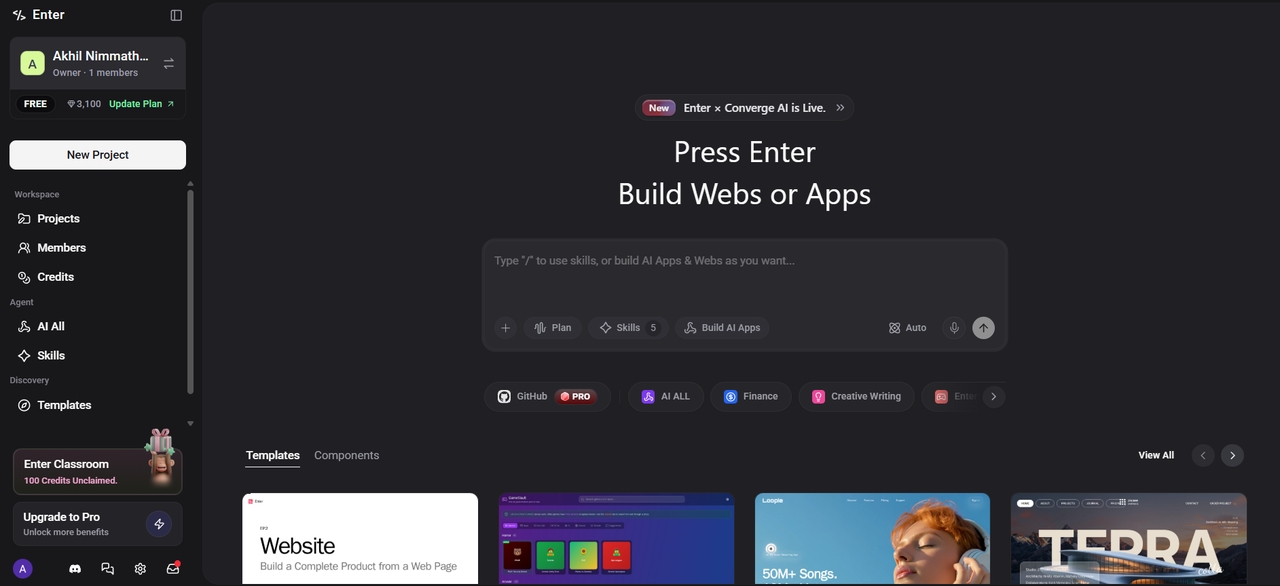
Many startups now use AI powered website building platforms to launch websites and digital experiences faster without relying heavily on development resources. Platforms like Enter Pro help founders create websites, landing pages, ecommerce stores, and AI-powered applications without needing a development team or technical expertise.
For early stage businesses, having a professional website alongside a compelling business pitch deck can strengthen brand visibility, improve customer trust, and support long term growth after fundraising efforts begin.
Key features of Enter Pro
- Multi-LLM orchestration: A unified API endpoint automatically routes prompts to leading models like Claude, GPT, and Gemini. This agentic workflow matches your coding, debugging, or design task with the specific AI model best suited to execute it.
- Auto-provisioned backend infrastructure: Natural language prompts instantly generate databases, secure authentication systems, and serverless functions. Enter Pro automatically configures full stack cloud infrastructure, helping startups avoid manual backend setup and complex DevOps management processes.
- Visual editing with exportable code: The platform combines a live visual editing canvas with clean exportable React and Tailwind CSS code. Teams can customize layouts, typography, and design elements visually while maintaining full control over the underlying source code.
- Real time collaborative workspaces: Real time collaborative workspaces allow founders, designers, and developers to work together seamlessly. Role-based access controls help manage editing permissions, deployment authority, and project collaboration securely across distributed teams.
Conclusion
Understanding what is a pitch deck is essential for startups looking to secure funding and communicate their vision effectively. A strong pitch deck helps founders explain their business idea, market opportunity, revenue model, and growth potential in a concise and engaging format. From attracting investors to building credibility, every slide plays an important role in shaping investor perception. Businesses should focus on clarity, storytelling, accurate data, and strong visual presentation to create an effective deck. Along with a compelling pitch, startups can also strengthen their growth strategy by building a professional online presence using modern platforms like Enter Pro.
FAQS
What is the main purpose of developing a business pitch?
The main purpose of developing a business pitch is to secure a follow up meeting with investors. It communicates your vision, demonstrates market opportunity, and builds enough confidence that an investor wants to learn more about your company.
What is the 10/20/30 rule for pitch deck?
The 10/20/30 rule suggests that a pitch deck should contain 10 slides, last no longer than 20 minutes, and use a minimum 30 point font size. This approach keeps presentations concise, clear, and easy for investors to follow and understand quickly.
What are the different types of pitch decks?
The main types are the email deck, sent ahead of a meeting with more detail and context, and the presentation deck, used during live pitches with cleaner visuals. Some founders also create a demo deck focused specifically on the product.
What is the difference between a pitch deck and a business plan?
A business plan is a detailed long form document covering operations, financials, and strategy. A pitch deck is a condensed visual version of that story, designed for quick consumption during a live presentation or investor email introduction.
How do investors evaluate a pitch deck?
Investors evaluate a pitch deck by reviewing the business idea, market size, competitive advantage, revenue model, traction, financial projections, and founding team. They look for clear growth potential, scalability, realistic planning, and strong market demand before making investment decisions.